Sale!

Banded Alabaster Egyptian Mace Head

Original price was: $2,000.00.Current price is: $1,850.00.

Description

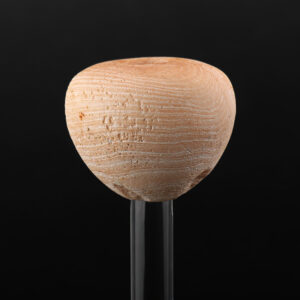
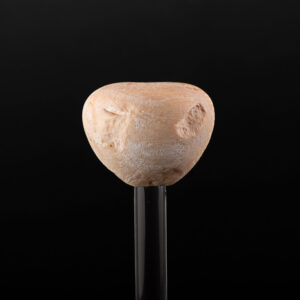
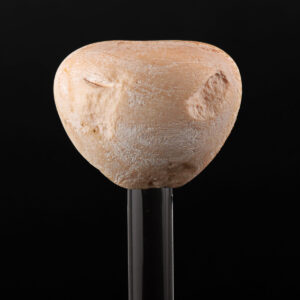
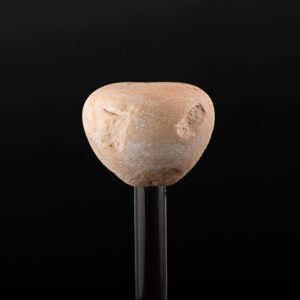
This commanding alabaster mace head exemplifies the artistry and technical skill of Egyptian stone‑workers of the Middle Bronze Age. Crafted from fine, dense alabaster, the piece presents a rounded, slightly pear‑shaped mass terminating in a short, tapering socket for hafting; its surfaces are smoothly finished to reveal the stone’s subtle veining and a soft, satin-like luster. Measuring approximately [dimensions available on request], it is a compact yet powerfully rendered implement.

The most striking feature of the mace head is its sculptural silhouette and the careful modulation of form between the striking face and the haft socket, which together create a balanced, purposeful object. The workmanship demonstrates mastery of stone‑shaping techniques, with precise contouring and evidence of controlled tool work around the socket and perimeter. Minor surface abrasions and faint impact marks may be present, consistent with functional use, while surviving tool marks are minimal and secondary to the overall polished presentation.

This object likely served both practical and symbolic roles: employed as a percussive weapon in conflict or as a status emblem and ceremonial object signaling authority and power. The selection of alabaster—a prized material—speaks to the prominence of its owner and the value attributed to finely

REFERENCE #

WP-PR-1002

CIVILIZATION

Egyptian, Circa 2100 B.C.E. – 1550 B.C.E.

Time Of Abraham

SIZE

L. 5cm

CONDITION

Fine condition

PRICE

$1850

PROVENANCE

The Baidun Collection

Banded Alabaster Egyptian Mace Head

This commanding alabaster mace head exemplifies the artistry and technical skill of Egyptian stone‑workers of the Middle Bronze Age. Crafted from fine, dense alabaster, the piece presents a rounded, slightly pear‑shaped mass terminating in a short, tapering socket for hafting; its surfaces are smoothly finished to reveal the stone’s subtle veining and a soft, satin-like luster. Measuring approximately [dimensions available on request], it is a compact yet powerfully rendered implement.

The most striking feature of the mace head is its sculptural silhouette and the careful modulation of form between the striking face and the haft socket, which together create a balanced, purposeful object. The workmanship demonstrates mastery of stone‑shaping techniques, with precise contouring and evidence of controlled tool work around the socket and perimeter. Minor surface abrasions and faint impact marks may be present, consistent with functional use, while surviving tool marks are minimal and secondary to the overall polished presentation.

This object likely served both practical and symbolic roles: employed as a percussive weapon in conflict or as a status emblem and ceremonial object signaling authority and power. The selection of alabaster—a prized material—speaks to the prominence of its owner and the value attributed to finely[/vc_column_text]

REFERENCE #

WP-PR-1002

CIVILIZATION

Egyptian, Circa 2100 B.C.E. – 1550 B.C.E.

Time Of Abraham

SIZE

L. 5cm

CONDITION

Fine condition

PRICE

$1850

PROVENANCE

The Baidun Collection

[/vc_column][/vc_row]

Sale!

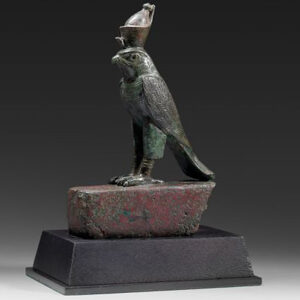
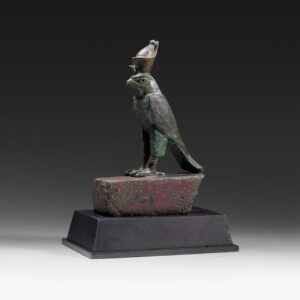
Bronze Figurine of Horus as a Falcon

Original price was: $49,000.00.Current price is: $45,000.00.

Description

Solid cast, the bird is shown in a typical pose, wings crossed over the tail with the feathers all cleanly incised. It wears the double crown of Egypt and traces of gilding remains scattered over the surface. This probably once decorated the top of a sarcophagus.

The so-called Horus falcon is one whose characteristics do not conform exactly with any of the four species known to the Egyptians: it is an idealized falcon with elements inspired by more than one of the predatory birds. The falcon was revered from earliest times for its awesome climb into the heavens and its headlong yet sure swoop upon its prey. The earliest element of the royal titulary, which officially proclaimed the ruler’s name, was the Horus name by which the holder of the royal office and the royal bird were indissolubly linked. Horus was essentially protective of the king and so an image of a falcon held an inherent concept of protection. But in one creation legend, the creator god was held to be a falcon whose outspread wings formed the vault of heaven, his two eyes being the sun and moon. Thus the image of the falcon was also strongly associated with creation and regeneration.

Not surprisingly it was a form adopted by a number of Egyptian gods. Even the name Horus refers to more than one deity since Horus of Edfu, Horus the son of Isis and Osiris and Horus the Elder are three completely separate gods with only the name in common; all could manifest themselves as a falcon. In addition, the sun god Re, Monthu the Theban war god, Sokar the Memphite funerary god, Khonsu of Thebes, even one of the Sons of Horus called Qebhsenuef could appear as falcons or falcon-headed (and there are others), with only special attributes to help distinguish each from the other and the multiplicity of Horuses. If none of these distinctive features is present and there is no inscription, identification of a falcon as being the manifestation of a specific deity is frequently impossible.

REFERENCE #

SI_EG_1047

CIVILIZATION

Egyptian, 26th/30th Dynasty, 664 B.C.E. – 342 B.C.E.


SIZE

H. 14.4 cm

CONDITION

Excellent condition

PRICE

$45,000

PROVENANCE

Former French private collection, acquired ca. 1970. French Passport # 128908

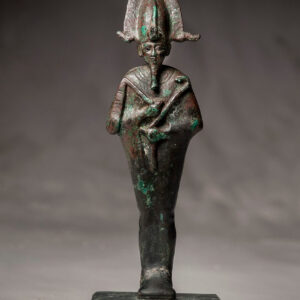
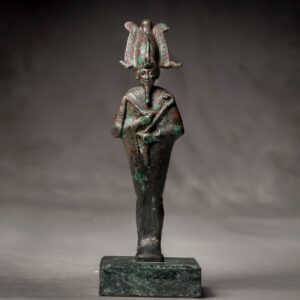
Bronze Statuette of Osiris

Bronze statuette of Osiris in traditional pose of arms crossed, holding a croREFERENCE #

SI_EG_1013

CIVILIZATION

Egypt, Late Period, 26th -30th Dynasty

SIZE

H. 22 cm

CONDITION

Fine condition

PRICE

$13,500

PROVENANCE

Private Jerusalem Collection, 1990s

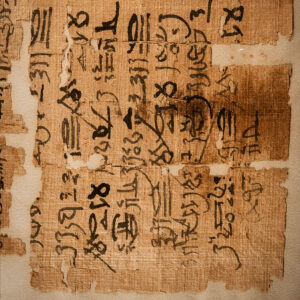
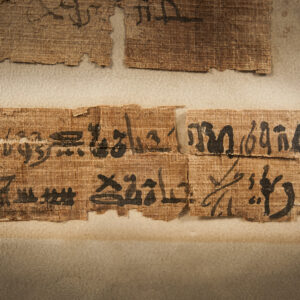
Papyrus Fragments of Egyptian Book of the Dead from Ptolemaic Period

Book of the Dead’ is a modern term for a collection of magical spells that the Egyptians used to help them get into the afterlife.  They imagined the afterlife as a kind of journey you had to make to get to paradise – but it was quite a hazardous journey so you’d need magical help along the way.

Prior to the New Kingdom, The Book of the Dead was only available to the royalty and the elite. The popularity of the Osiris Myth in the period of the New Kingdom made people believe the spells were indispensible because Osiris featured so prominently in the soul’s judgment in the afterlife. As more and more people desired their own Book of the Dead, scribes obliged them and the book became just another commodity produced for sale.

In the same way that publishers in the present day offer Print on Demand books or self-published works, the scribes offered different “packages” to clients to choose from. They could have as few or as many spells in their books as they could afford. Bunson writes, “The individual could decide the number of chapters to be included, the types of illustrations, and the quality of the papyrus used. The individual was limited only by his or her financial resources” (48).

From the New Kingdom through the Ptolemaic Dynasty (323 – 30 BCE) The Book of the Dead was produced this way. It continued to vary in form and size until c. 650 BCE when it was fixed at 190 uniform spells but, still, people could add or subtract what they wanted to from the text. A Book of the Dead from the Ptolemaic Dynasty which belonged to a woman named Tentruty had the text of The Lamentations of Isis and Nephthys attached to it which was never included as part of the Book of the Dead. Other copies of the book continued to be produced with more or less spells depending on what the buyer could afford. The one spell which every copy seems to have had, however, was Spell 125.

Featured here are several papyrus fragments of the Egyptian Book of the Dead from Egypt’s Ptolemaic Era (305 – 30 BCE).  Examining Egyptian art during these 300 years reveals strong continuities in its traditions but also interactions with Greek art, whose forms and styles swept the world with Alexander’s armies. The encounter of the two cultures had many aspects and phases, and is easiest to comprehend by looking first at the new ruling class, its involvements and concerns, and then at religion and the arts in the greater land of Egypt.


FOOTNOTES:
1.) The British Museum

2.) Ancient.eu

3.) Met Museum

REFERENCE #

MS_EG_1003


CIVILIZATION

Egyptian

SIZE

Varying…

CONDITION

Fine Condition

PRICE

Price upon request

PROVENANCE

Baidun Collection

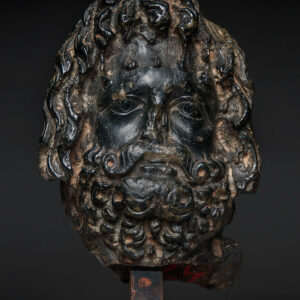
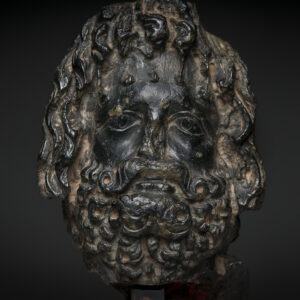
Roman-Egyptian Schist Stone Head Bust of Greco-Egyptian god Zeus Serapis

Roman-Egyptian Schist Stone Head Bust of Greco-Egyptian god Zeus Serapis

This Roman-Egyptian head bust of the Greco-Egyptian god Zeus Serapis is finely sculpted from black schist stone, and dates from the Roman-Egyptian Period, 100 C.E. – 200 C.E.  Representations of Serapis are uncommon.  The most famous representation of the deity is that by Bryaxis, the famous sculptor who is credited with creating the sculptures on the north side of the tomb of Maussollos – one of the wonders of the ancient world.  Other works of Bryaxis include a bronze statue of Seleucus, king of Syria, five huge statues at Rhodes, and a statue of Apollo at Daphne near Antioch.

The depiction of Serapis is uncommon, and this sculptor’s attention to detail is evident in all aspects of the piece:  Wavy hair locks flow elegantly down the back and sides of Serapis’ head, as hair bangs drape across his forehead.  His thick, full beard of curly hair locks covers his face in the classic style of ancient Greece which regarded the beard as a badge or sign of virility; Greek beards were also frequently curled with tongs.

Even though from the earliest times in ancient Greece the shaving of the upper lip was not uncommon, here Serapis is depicted with full handlebar mustache which curls upward on both sides of his face, revealing only his bottom lip.  The superb craftsmanship of this piece is manifest down to the finest details in Serapis’ eyes which reveal the corneas that are clearly distinguishable from the sclera of each eye, and each is accentuated by delicate, finely-crafted eyelids as well as with expressive, arched eyebrows which are visible under the hair bangs.

Some of these hair locks that cover the forehead are missing, as well as part of the nose which were broken in antiquity.  The cult of Serapis was banned in 391 C.E. and many of the sculptures destroyed.  Therefore this fine specimen is an uncommon example that has survived the ravages of history, and thus is a very notable piece of rare ancient art.


The Cult of Serapis / Sarapis

The cult of Serapis was introduced during the 3rd century B.C.E. on the orders of Ptolemy I of Egypt as a means to unify the Greeks and Egyptians in his realm.  Sarapis was a syncretistic deity derived from the worship of the Egyptian Osiris and Apis (Osiris + Apis = Oserapis/Sarapis).

Serapis also gained attributes from other deities, such as chthonic powers linked to the Greek Hades and Demeter, as well as benevolence linked to Dionysus.  However, although he was identified with various Greek gods, Serapis was above all – because of his authority and his association with rulers (the Ptolemies in this case) – identified with Zeus.

Ptolemy I Soter (r. 305–284 B.C.E) commissioned the syncretistic god Serapis in order that the native population of Egypt – who already had an extensive pantheon of deities – and the occupying forces of Greece could have a common ritual focus, and he centered the worship of the deity at Alexandria.  Serapis (or Sarapis) was a Greco-Egyptian deity of the Sun first encountered at Memphis where his cult was celebrated in association with that of the sacred Egyptian bull Apis (who was called Osorapis when deceased).  The god therefore shared a group of attributes common to Greeks (physically robust, bearded male) and to Egyptians (attire and accessories).  He was originally shown seated, with a sceptre of power, wearing a grain measure on his head, accompanied by a snake (identified with the Egyptian royal uraeus) and with a dog (originally held to be Anubis, later Cerberus) by his side.


Sources:

1.) Art Fund – Bust of Zeus Serapis by Greek

2.) Met Museum – Gold statuette of Zeus Serapis

3.) Britannica – Serapis

4.) Britannica – Apis

5.) Britannica – Ptolemy I Soter

6.) Wikipedia – Serapis or Sarapis

7.) Wikipedia – Beards in Ancient Greece

8.) Wikipedia – Bryaxis

9.) University of Chicago – The Temple of Serapis at Alexandria

10.) Book – “Zeus” by Ken Dowden[/vc_column_text]

REFERENCE #

SI_RM_1099

CIVILIZATION

Roman-Egyptian Period, 100 C.E. – 200 C.E.

SIZE

H. 11.4 cm

CONDITION

Fine condition, some of the hair locks from the forehead are missing.

PRICE

$23,000

PROVENANCE

Ex French private collection, acquired 1975.

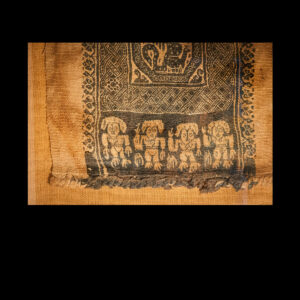
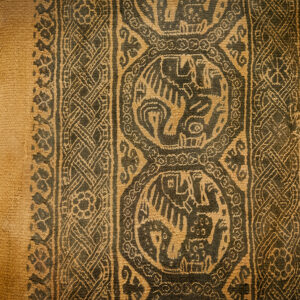
Woven Cloth with Lion Frieze and Ornamental Bands

Important Woven Cloth with Lion Frieze and Ornamental Bands. Two-coloured tapestry weave in silhouette style, fine-threaded, dark grey and beige.

Rectangular length of cloth with centred vertical frieze of rampant lions with arching tails inside adjoining octagonal frames on a light-coloured ground, surrounded by a band of dense braiding with inside hatching alternating with flowers. Schematic palmettes in the spaces in between. Outer ornamental band of hanging rhombi. Lined up along the narrow edge at the bottom are four light-coloured, stocky human figures with bird’s feet, some with their left arm raised, set against a dark ground with fringed border below them. Fragment of a hanging

Sewn onto linen and framed. For style, ornamental structure and iconography, cf. Effenberger – 1976, 178, 216 f., 239, 270 f., pls. 119, 121, 125 (of later date, but with the same composition); Cat. Vienna – 2005, 155 f., no. 92 with illus.


REFERENCE #

TX_EG_1001

CIVILIZATION

Egypt, Coptic, 500 C.E. – 700 C.E.

SIZE

L. 99.2 cm, W. 26.5 cm

CONDITION

Fine Condition

PRICE

Price available upon request

PROVENANCE

Coll. A. and E. Offermann, Cologne (1965–2012). – Formerly private collection of Reichskanzler Franz von Papen (1879–1969), from June–December 1932 last but one Reichskanzler of the Weimar Republic, from January 1933 to July 1934 vice-chancellor in Hitler’s cabinet, later ambassador of the German Reich in Vienna and Ankara. Acquitted at the Nuremberg Trials of 1946, but one year later as one of the main culprits condemned to eight years in a labour camp as part of the denazification of Germany. Purchased in 2004 from Roswitha Eberwein, Antike Kunst, Göttingen. Declaration of provenance on back of frame: “Sammlung von Papen”.