Sale!

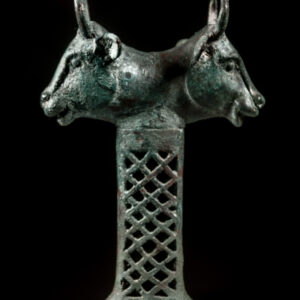
Bronze Double-Headed Bull Mace Head

Original price was: $30,000.00.Current price is: $25,000.00.

Description

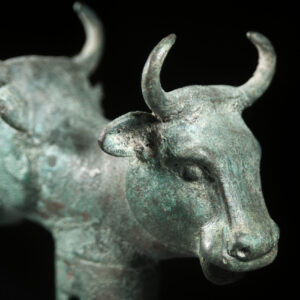
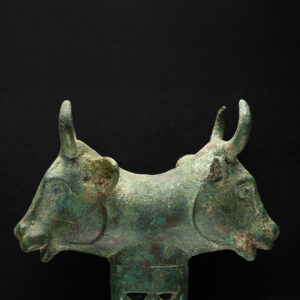
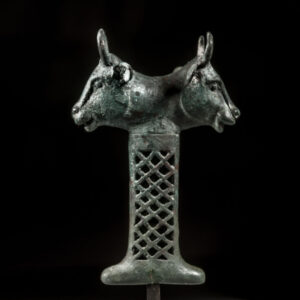
This Elamite Bronze Double-Headed Bull Mace Head, originating from the Near East region circa 2100–1550 B.C.E., is a striking example of ancient artistry and symbolism. The mace head features two imposing bull heads sculpted with remarkable detail and power, with their facial features exuding strength and dominance.

The bulls’ horns and expressions reflect the reverence for these animals in ancient cultures, often symbolizing fertility, power, and protection.

The handle, crafted in an openwork lattice style, showcases the artisan’s advanced skill in metalworking. The lattice pattern adds both aesthetic beauty and functional lightness to the piece. Though one of the bulls’ ears shows an ancient loss, the artifact remains in fine condition, its surface adorned with a rich natural patina, adding to its historical authenticity and appeal.

In the ancient Elamite kingdom, bulls were potent symbols of strength, fertility, and divine power, often associated with deities and rulers. This double-headed bull mace head likely held ceremonial or ritual significance, symbolizing authority, protection, or a connection to the divine. Its exquisite craftsmanship speaks to the advanced skills of the ancient Near Eastern metalworkers and their ability to imbue objects with profound cultural meaning.

REFERENCE #

WP_AT_1001

CIVILIZATION

Persian, Middle Bronze 2100 B.C.E. – 1550 B.C.E.

SIZE

L. 19 cm, W. 13 cm

CONDITION

Fine condition.

PRICE

$24850
Bronze Double-Headed Bull Mace Head

$25,000.00

This Elamite Bronze Double-Headed Bull Mace Head, originating from the Near East region circa 2100–1550 B.C.E., is a striking example of ancient artistry and symbolism. The mace head features two imposing bull heads sculpted with remarkable detail and power, with their facial features exuding strength and dominance.

The bulls’ horns and expressions reflect the reverence for these animals in ancient cultures, often symbolizing fertility, power, and protection.

The handle, crafted in an openwork lattice style, showcases the artisan’s advanced skill in metalworking. The lattice pattern adds both aesthetic beauty and functional lightness to the piece. Though one of the bulls’ ears shows an ancient loss, the artifact remains in fine condition, its surface adorned with a rich natural patina, adding to its historical authenticity and appeal.

In the ancient Elamite kingdom, bulls were potent symbols of strength, fertility, and divine power, often associated with deities and rulers. This double-headed bull mace head likely held ceremonial or ritual significance, symbolizing authority, protection, or a connection to the divine. Its exquisite craftsmanship speaks to the advanced skills of the ancient Near Eastern metalworkers and their ability to imbue objects with profound cultural meaning.[/vc_column_text]

REFERENCE #

WP_AT_1001

CIVILIZATION

Persian, Middle Bronze 2100 B.C.E. – 1550 B.C.E.

SIZE

L. 19 cm, W. 13 cm

CONDITION

Fine condition.

Canaanite Large Decorated Spear Head

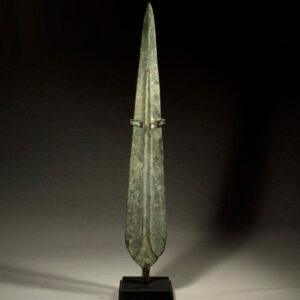
This magnificent leaf-shaped spear head was made by the Canaanites in the mid to late 2nd millennium B.C.E.. It displays excellent engineering and structural elements, particularly in terms of the bilateral central longitudinal fortified rib, widening to a broad tabular section at the butt end which was used to haft the spear head onto the shaft. The body tapers in both frontal and lateral profiles, making it a lethally effective weapon. The size also counts against anything other than a martial function, while the status associated with both warriors and large quantities of bronze (an expensive commodity at the time) marks it out as an important artifact.

Where found in context, such pieces are typically associated with prestige graves, and it would appear that they were probably as important in terms of appearance (i.e. conspicuous governance and threat) as in their evident lethality in combat. Indeed, at almost half a metre long, this piece would have been a very imposing item at the time of its manufacture, as indeed it is now. There is considerable evidence for diversity of manufacture across the Canaanite area, perhaps reflecting something of the modular yet martial nature of the time.

The Canaanites were one of the ‘tribal’ groups of what was to become Israel, Palestine and Jordan, who had their cultural roots in the Neolithic revolution when agriculture revolutionised Near East economics. By the Bronze Age the stability of the area and their position between great trading powers – notably Egypt and Mesopotamia – made them prosperous and culturally diverse, and was a high point for artistic creation. The culture contracted with economic issues suffered by Egypt and the Mesopotamians, and went through a collapse at the end of the Bronze Age due to a combination of ‘Sea People’ invasions, environmental meltdown and internal troubles in Egypt leading to loss of infrastructure throughout the Near East. Their resurgence of power in the Iron Age was matched by that of the Ammonites and Moabites, among others, and the region eventually came under control of the Neo-Assyrians by the mid 8th century B.C.E.. Such symbols of conspicuous consumption and authority are rare, especially in this excellent state of preservation and exquisite patination. This is an attractive and elegant piece of ancient art.

REFERENCE #

WP_PR_1043

CIVILIZATION

Canaanite, 1400 B.C.E. – 900 B.C.E.

SIZE

L. 47.5 cm

CONDITION

Fine condition

PRICE

Price available upon request