
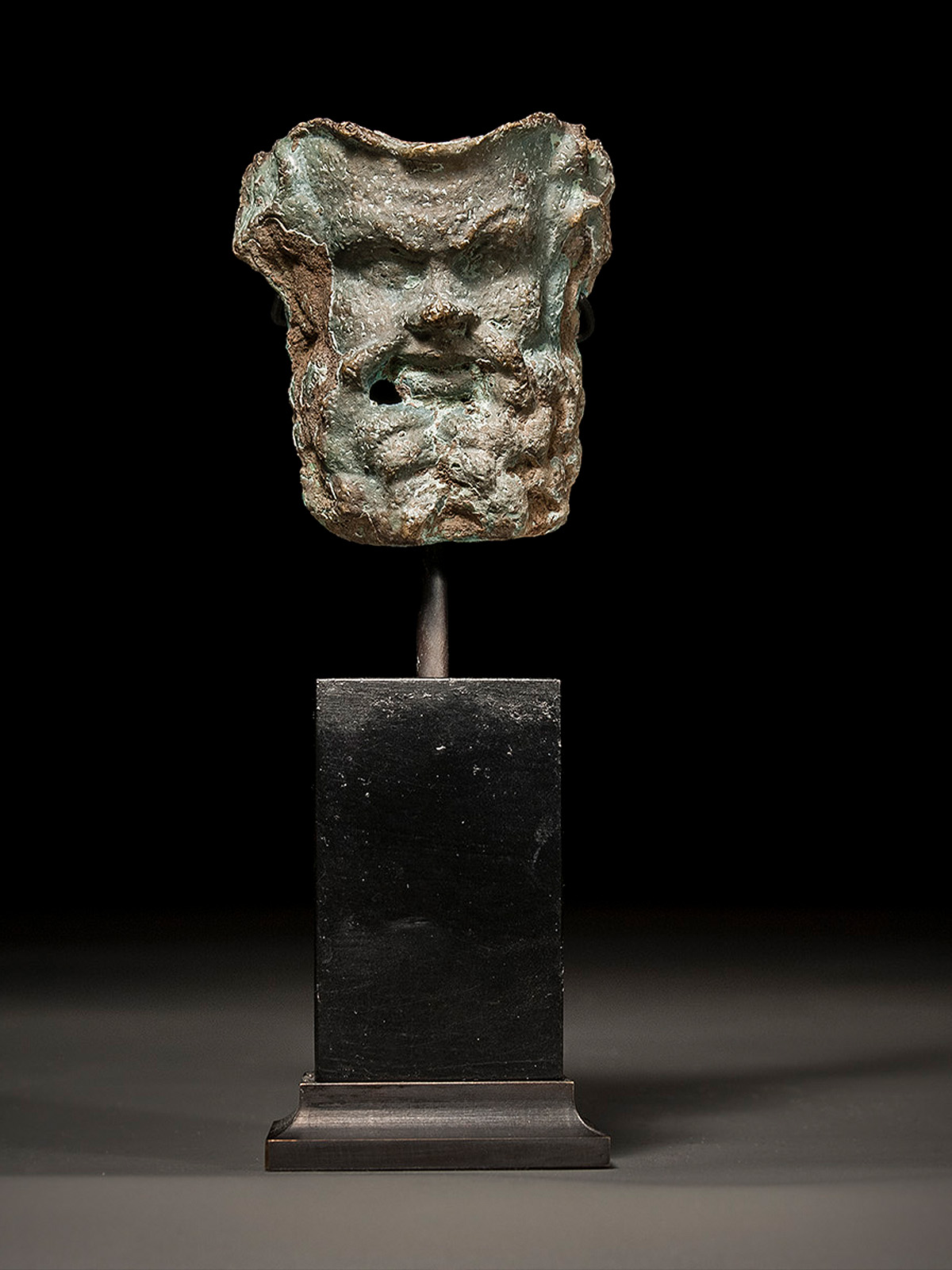
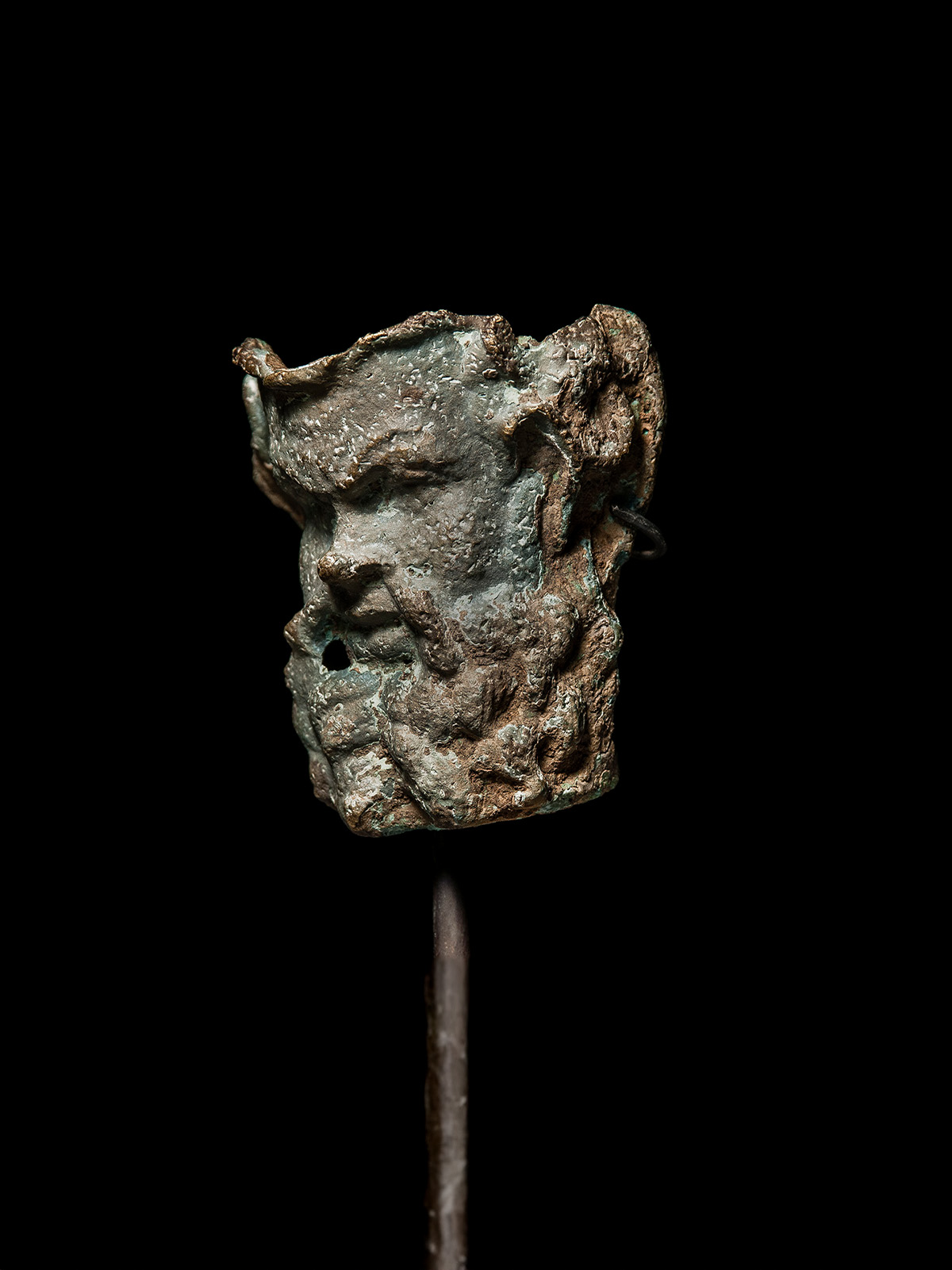
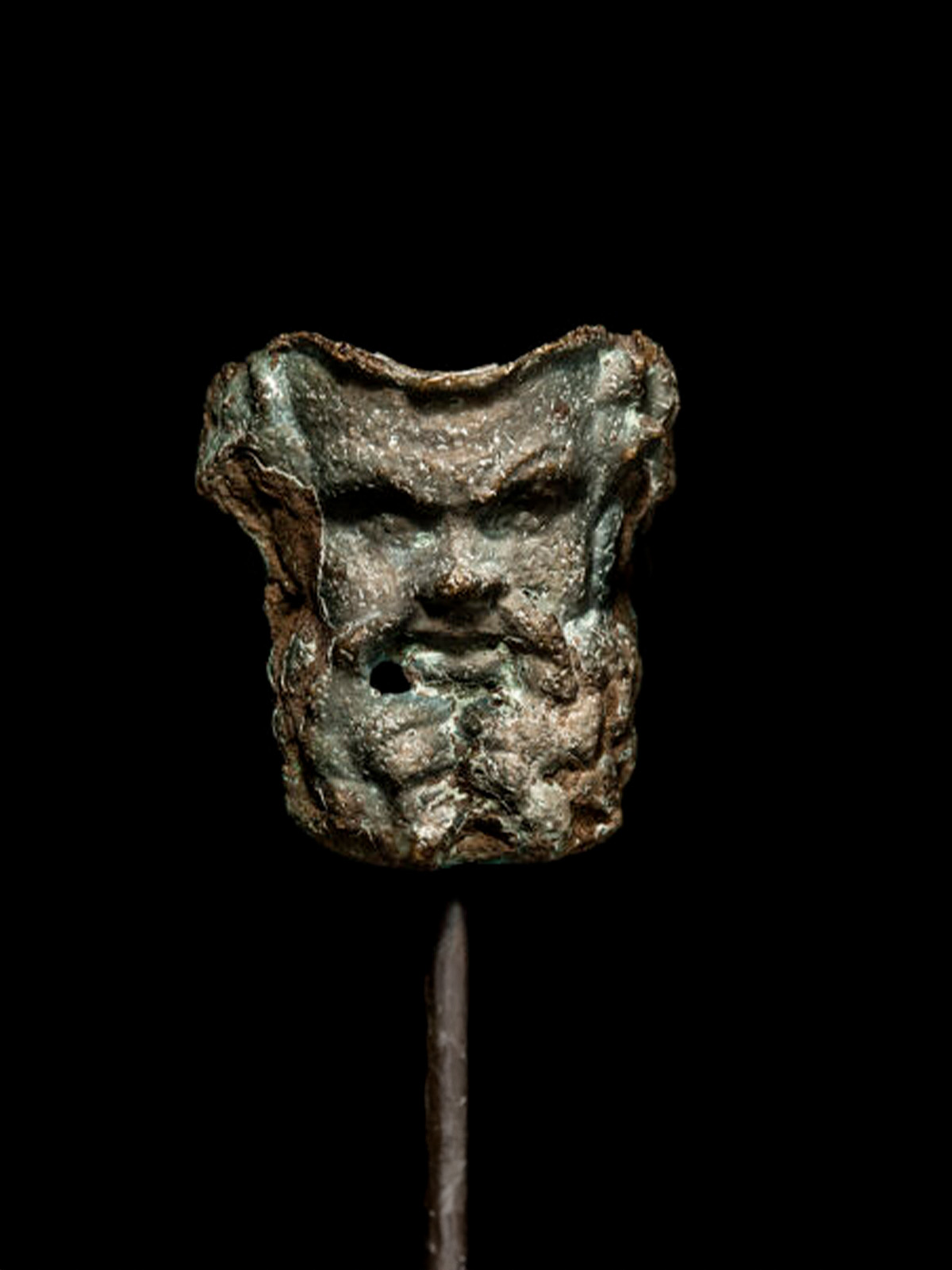
Here Silenus is depicted as an old satyr with a long mustache and a square beard with big curling hair locks. The face has strong features with chubby cheeks, snub-nose, fleshy lips, frowning brows, as well as pointed ears with ivy leaves set over both of them. The face is finely modeled with a strong and living expression. It is framed with a contour line at the border of the missing upper and back parts of the head.
Such a facial depiction was applied on a statue which was possibly made of other material. The punched surface of the face may indicate that it was plated or sheathed with silver or gold.
Classical Depictions of Silenus
A notorious consumer of wine, Silenus was usually drunk and had to be supported by satyrs or carried by a donkey. When intoxicated Silenus was said to possess special knowledge and the power of prophecy: It was believed that he acquired arcane knowledge and was able to predict the future. Seilenos was, in essence, the spirit of the treading dance of the wine-press – his name being derived from the words seiô, “to move to and fro,” and lênos, “the wine-trough.”
Reference:
For the style:
cf. Smith, R.R.R., Hellenistic Sculpture, Thames and Hudson, London 1991, fig. 299; Stewart, A., Greek Sculpture. An Exploration, II ( plates ), Yale University Press, New Haven & London, 1990, figs. 684, 708.
For a similar Etruscan Satyr:
cf. Mitten, D. G., and Doeringer, S. F., editors, Master Bronzes from the Classical World, Exh. cat., Fogg Art Museum, Cambridge, Mass., 1967, p.222, fig. 225.
For Silenus’ head:
cf. Ibid, p. 125, fig. 125.
Sources:
1.) Britannica – Satyr
2.) Wikipedia – Silenus
3.) Theoi – Seilenos
4.) Greek Mythology – Silenus