A Large Glass Bowl with A Pedestal Foot

Description

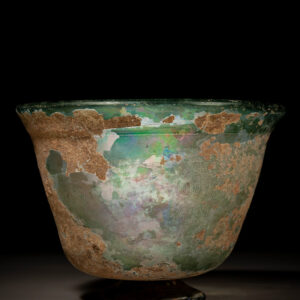
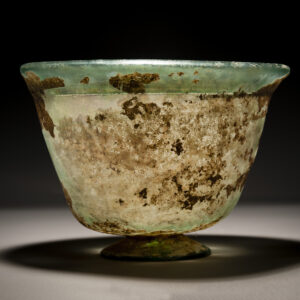
This large glass bowl comes from Samaria, the capital of ancient Israel in the 9th century B.C.E. and 8th century B.C.E.. Located just west of the Jordan River, Samaria was a vibrant city for many centuries; its history is recounted in the Old Testament book of Kings. It experienced many invasions over the intervening centuries located as it was in the strategic mountains of Judea.

By the time this beautiful aquamarine bowl was blown, Samaria had come under Roman rule, a period of great innovation as new Roman technology filtered throughout the region.

REFERENCE #

KB_GL_9987

CIVILIZATION

Early Roman Period 100 C.E.

SIZE

D. 15 cm

CONDITION

Fine condition

PRICE

Price available upon request
Sale!

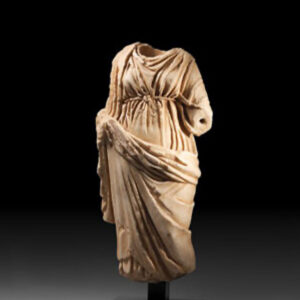
A Marble Statue of a Drapped Female

Original price was: $90,000.00.Current price is: $85,000.00.

This female body is an interesting example of a Roman sculptor playing with the form of fabric as it drapes in thick folds over this woman’s strong figure. The head of this sculpture has been lost to time, yet we are able to understand that the woman we look upon was of a high standing due to her lush clothing and upright stance.

The skill of the sculptor who carved this piece is seen in the movement of the woman’s himation, or draped robe, as it both cinches below her bosom and sweeps across her waist as it is held back by her right hand. The result is a beautiful statement that highlights her full figure even under the weight of her thick robe.

REFERENCE #

SI_RM_1068

CIVILIZATION

Roman, 200 C.E. – 300 C.E.

SIZE

H. 66 cm

CONDITION

Fine condition

PRICE

$85,000

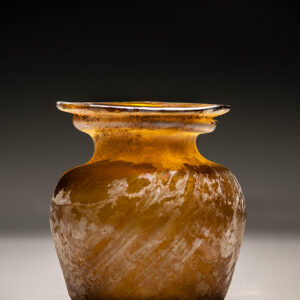
A Roman Amber Glass Jar with Diagonal Ribbing

Description

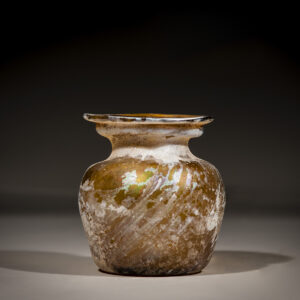
The craftsmen of Ancient Rome were constantly innovating to perfect their methods, while reaching new heights of early artistry. The swooping ribbons on the body of the amber glass jar may seem like a simple stylized effect, yet it represent the fine work of a dedicated glassblower using the most rudimentary of tools to create a truly unique piece of filled with ancient beauty.

Only 7 cm in height, this squat jar would have held the perfumes or ointments used daily to embellish the scent or cheeks of an ancient Roman citizen.

REFERENCE #

KB_GL_9990

CIVILIZATION

Roman, 100 C.E. – 300 C.E.

SIZE

H. 7 cm

CONDITION

Fine condition

PRICE

Price available upon request
Ancient Roman Bronze Statue (Statuette) of a Finely Detailed Roman Eagle

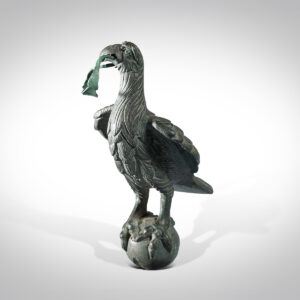
Ancient Roman bronze eagle statue (statuette) of a Roman eagle holding a crown in its beak showing finely detailed metalwork by the artist in the feathers, face and talons.  The wings of the metal eagle are slightly raised from its side and the legs are close together set on thick talons.

The majestic eagle, being one of the traditional Roman symbols, stands atop a bronze orb which represents the dominion of Rome over the world.  A simple crown of laurels hangs from the bird’s beak in a nod to the eagle’s close association with the royalty of ancient Rome.

The eagle, was a prominent symbol used in ancient Rome, especially as the standard of a Roman legion.  A Roman legionaire known as an aquilifer, or eagle-bearer, was the standard bearer who carried this standard on Roman military conquests.  Each Roman legion carried one eagle.   The eagle was extremely important to the Roman army, beyond merely being a symbol of a legion.   A lost standard was considered an extremely grave occurrence, and the Roman military often went to great lengths to both protect a standard and to recover it if lost.

For example, see the aftermath of the Battle of the Teutoburg Forest, where the Roman army spent decades attempting to recover the lost standards of three Roman legions. That’s why they are relatively small size, since a standard bearer in circumstances of danger will wrench the eagle from its staff and conceal it in the folds of his girdle.

REFERENCE #

SI_RM_1090

CIVILIZATION

Roman, 200 C.E. – 300 C.E.

SIZE

H. 10.2 cm

CONDITION

Excellent condition

PRICE

SOLD

PROVENANCE

Ex private collection, acquired before 1973.