A Fine Egyptian Gypsum Mask of a Young GirlOut of stock

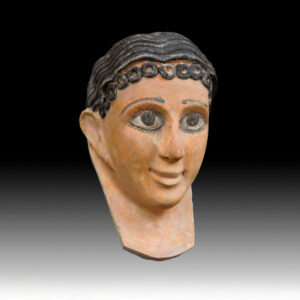
A Fine Egyptian Gypsum Mask of a Young Girl

Plaster mummy portrait of a young girl, with slender features and tan flesh tones. Her full lips are pursed into a smile, rendering her features serene. Her black hair is molded with front row of small curls, and parted in the middle hair fashion. The eyes and eyebrows are stylistically delineated with black lines and beautiful lashes. She is wearing a pair of earrings. Areas of linen wrappings are preserved on the interior.


REFERENCE #

SI_EG_1053

CIVILIZATION

Ptolemaic period, 305 B.C.E. – 30 B.C.E.

SIZE

H. 29 cm

CONDITION

Professional restoration on the paint and the plaster, overall in fine condition

PRICE

SOLD

An Etruscan Female Votive Head

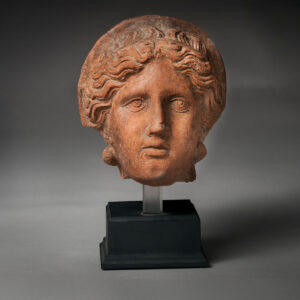
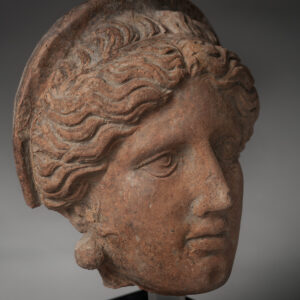
The front of the head is made from a mold and with a modeling tool reworked.  The rear is Hollow. The sculpture shows a young female’s head in frontal orientation The even facial features women are very attractive.  Expressive, with deep-set eyes coupled with strong eyelids. The pupils are clearly defined. A Strong protruding nose and full lips slightly opened. the chin has a gentle dimple. The symmetrically styled hair is parted in the middle, starting in soft curls that are combed back. On the cheeks is a single sleeping curls, and round earrings. The hairstyle is held by a headband. More curls on Top of the head are covered by a corona.

Cf .: St. Ohlig , antique cabinet, catalog no. 3 ( 1998) ” The Etruscans , a sign of life Civilized people . ” Fig.53 .


REFERENCE #

P 20753

CIVILIZATION

Greek, 400 B.C.E.

SIZE

H. 19.5 cm

CONDITION

A small chip on the tip of the nose, otherwise in Fine quality,

PRICE

Price available upon request

PROVENANCE

Private collection of Dr. Ludenscheid , acquired in the 1960s


An Expressive Greek Head of a Satyr

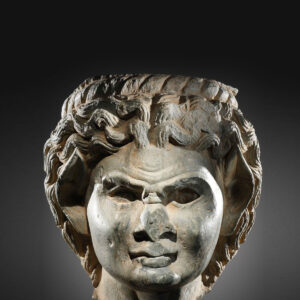
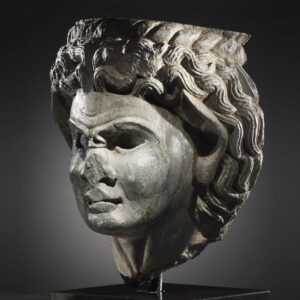
The expressive face of this satyr reveals a right eye that is slightly lower than the left and a smirk carved purposefully askew. The satyr himself may be of Greek origin, yet this piece hails from central Asia, a result of the clash of cultures that arose out of Alexander the Great’s successful campaigns throughout the region. The result was a vast melting pot of culture, art and religion that spanned the subsequent Hellenistic era of Greek history, when Greek cultural influence and power was at its zenith in Europe and Asia. At the time, this satyr’s inlaid eyes and simple braided crown were uncommon in Asian art, particularly seen in Buddhist sculptures of Siddhartha from the Gandhara region of northern Pakistan. Other examples include the famous Parthian relief from Hatra, as well as the hair and head of the Peshawar Museum’s Bodhisattva. In the years after Alexander’s conquests, the region’s sculpture incorporated such elements in the intervening years as trade and technology increased the mingling of Eastern and Western cultures, creating new currents of art and thought that still inspire us to this day.

The round face is dominated by deep holes for eyes which were originally inlaid. The root of the nose is strongly furrowed, as too is the forehead above, its series of wavy grooves mirroring the curvature of the expressive high-arched brows. Prominent cheekbones, with fleshy, rounded cheeks below; under the broad nose, full sensuous lips with dimples. To either side of the face, long, pointed ears with deep auricles. A exuberant shock of curling locks, whose individual strands are articulated with incised lines, is parted in the middle to form an anastole and spreads outwards in three luxuriant strands to frame the face.

Similarly rendered locks entirely envelope the head, wig-like, in schematically arranged rows. The sinews of the neck form a pronounced V-shape. The combination of glowering features and unruly hair impart to the head an intensely expressive quality. Encircling the crown of the head is a rope-like wreath which served as the base for an attachment, its upper surface flat to accommodate another element. Head of a statue, in all likelihood an architectural support such as a Caryatid.


REFERENCE #

SI_GR_1003

CIVILIZATION

Central Asia, with influence from Ghandara, 200 B.C.E. – 100 B.C.E.

SIZE

Ht. 24cm

CONDITION

Damage to nose, chin and two locks of hair.

PRICE

$95,000

PROVENANCE

Private Collection R.J. 1962.

Archaic Bronze Greave

The shape of this bronze shin guard or ‘greave’ is emphasized by the exaggeration of the anatomical muscular structure, on one side a deep crescent-shaped groove and a bulge indicates the position of the calf. The arched upper end protected the knee joint. Above the ankle, the outline of the plaque is rounded and slightly flared to allow for movement.

REFERENCE #

WP_GR_1010

CIVILIZATION

Greek, 600 B.C.E.

SIZE

H. 42 cm

CONDITION

Minor repairs for cracks, and some reinforcements done from the inside

PRICE

Price available upon request

PROVENANCE

Previously in a private Japanese collection since the 1970’s


Greek Ceramic Figurine of a Sphinx

According to ancient literary sources, the sphinx was a monster with the face and bust of a woman, the talons of a lion, the body of a dog, a serpent’s tail and wings of a bird. Its pale appearance, venomous mouth and stony gaze characterised this demon of divine origin. Its presence amongst humans created uncertainty and fear. It is possible that this hybrid had its origin in Egyptian iconography, where it was represented with the body of a feline and a human face, and was probably related to the divine power of the pharaoh.

This terracotta piece shows a monster seated on its haunches and in profile, with its head turned to the right toward the public. The female countenance has idealised features of great beauty. The thick, wavy hair is crowned with a polos or crown on the Corinthian model. On the right wing the rendering of the feathers shows a clear interest in the anatomical details of birds: the feathers inserted into the body itself are small and short, rather like scales, while those at the extreme end of the wing are long and narrow, to help the bird take flight.

The sculptural prototype of Greek sphinxes appears around the 7th century BC in terracotta, and was usually found decorating large receptacles. A century later they appeared in marble crowning seated ex-votos on a column. The monstrous, aggressive nature of the hybrid was channelled into funerary art, serving as an apotropaic symbol to keep away malevolent forces. It was usual, therefore, to find this iconography in metopes and hollow acroteria in Greek necropoleis of the 6th century BC, usually with the animal in profile and turning its head toward the public in an attitude of defiance.


BIBLIOGRAPHY:

  • BILLOT, M.F. “Le Sphinx du Louvre CA 637”, Bulletin de Correspondence Hellénique. 1977.
  • MARCONI, C. Temple Decoration and Cultural Identity in the Archaic Greek World. Getty Foundation. 2007, p. 90.
  • RENGER, A.B. Oedipus and the Sphinx: The Threshold Myth from Sophocles through Freud to Cocteau. UCP. 2013.
  • STILLWELL, A. N. Corinth: The Potters’ Quarter. Harvard Univ. Press. 1952.

Reference #

SI_GR_1034

Civilization Greek,

6th – 5th century B.C.E.

Size

H. 18 cm

Condition

In a good state of preservation, without any restoration.

Provenance,

Private collection G. A., Gardena, California, USA.

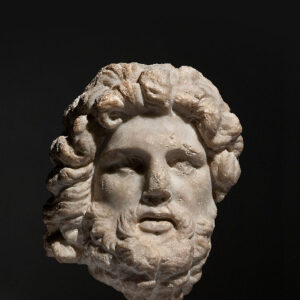
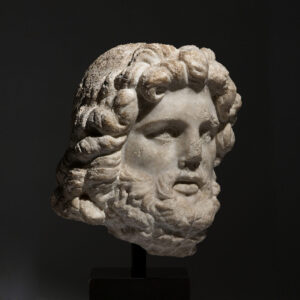
Hellenistic Marble Head of Zeus

Zeus’ imposing presence was felt throughout Ancient Greece as evidenced by the many sculptures and paintings of his image that make up the region’s archaeological record. This white marble sculpture of Zeus dates from Greece’s Hellenistic period of approximately 300-200 B.C.E., a time when Greek sculpture had entered a Classical period defined by its rigid poses and severe features. This figure’s lush hair, parted lips, and strong brow show the emphasis placed on such stylized details during Greece’s Classical period.

This sculpture is a highly realistic representation of Zeus, and it may be that the sculptor based this image on someone he knew from his everyday life. This sculpture is a breathtaking example of the technical skill and detailed eye of Greece’s celebrated sculptors. The piece has been restored to reveal the sculpture’s original power, although the body has been lost to history’s vagaries.

REFERENCE #

SI_GR_1011

CIVILIZATION

Greek Hellenistic, 300 B.C.E. – 200 B.C.E.

SIZE

H. 30 cm

CONDITION

Fine condition

PRICE

P.O.R

PROVENANCE

English Private Collection of a German Professor, ca 1970’s


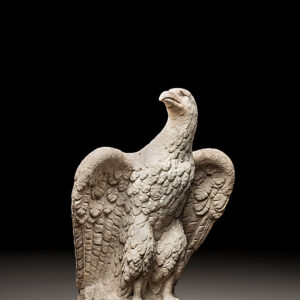
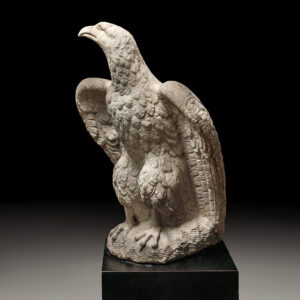
Monumental Imperial Roman Marble Eagle

Description

A large and imposing majestic Roman marble eagle, straight gaze, with its wings spread and legs bent preparing to take flight

REFERENCE #

SI_RM_1100

CIVILIZATION

Roman, 100 C.E. – 200 C.E.

SIZE

H. 64 cm

CONDITION

The beak is restored, otherwise in perfect condition.

PRICE

Price available upon request

PROVENANCE

French Private Collection purchased in Paris in the 1970’s.


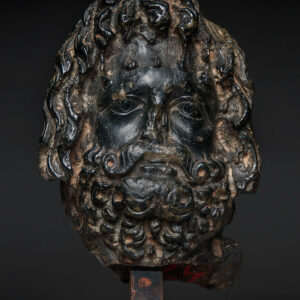
Roman-Egyptian Schist Stone Head Bust of Greco-Egyptian god Zeus Serapis

Roman-Egyptian Schist Stone Head Bust of Greco-Egyptian god Zeus Serapis

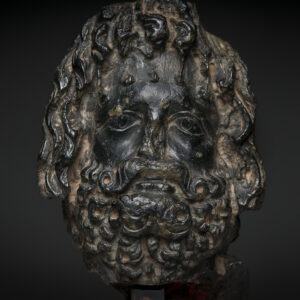
This Roman-Egyptian head bust of the Greco-Egyptian god Zeus Serapis is finely sculpted from black schist stone, and dates from the Roman-Egyptian Period, 100 C.E. – 200 C.E.  Representations of Serapis are uncommon.  The most famous representation of the deity is that by Bryaxis, the famous sculptor who is credited with creating the sculptures on the north side of the tomb of Maussollos – one of the wonders of the ancient world.  Other works of Bryaxis include a bronze statue of Seleucus, king of Syria, five huge statues at Rhodes, and a statue of Apollo at Daphne near Antioch.

The depiction of Serapis is uncommon, and this sculptor’s attention to detail is evident in all aspects of the piece:  Wavy hair locks flow elegantly down the back and sides of Serapis’ head, as hair bangs drape across his forehead.  His thick, full beard of curly hair locks covers his face in the classic style of ancient Greece which regarded the beard as a badge or sign of virility; Greek beards were also frequently curled with tongs.

Even though from the earliest times in ancient Greece the shaving of the upper lip was not uncommon, here Serapis is depicted with full handlebar mustache which curls upward on both sides of his face, revealing only his bottom lip.  The superb craftsmanship of this piece is manifest down to the finest details in Serapis’ eyes which reveal the corneas that are clearly distinguishable from the sclera of each eye, and each is accentuated by delicate, finely-crafted eyelids as well as with expressive, arched eyebrows which are visible under the hair bangs.

Some of these hair locks that cover the forehead are missing, as well as part of the nose which were broken in antiquity.  The cult of Serapis was banned in 391 C.E. and many of the sculptures destroyed.  Therefore this fine specimen is an uncommon example that has survived the ravages of history, and thus is a very notable piece of rare ancient art.


The Cult of Serapis / Sarapis

The cult of Serapis was introduced during the 3rd century B.C.E. on the orders of Ptolemy I of Egypt as a means to unify the Greeks and Egyptians in his realm.  Sarapis was a syncretistic deity derived from the worship of the Egyptian Osiris and Apis (Osiris + Apis = Oserapis/Sarapis).

Serapis also gained attributes from other deities, such as chthonic powers linked to the Greek Hades and Demeter, as well as benevolence linked to Dionysus.  However, although he was identified with various Greek gods, Serapis was above all – because of his authority and his association with rulers (the Ptolemies in this case) – identified with Zeus.

Ptolemy I Soter (r. 305–284 B.C.E) commissioned the syncretistic god Serapis in order that the native population of Egypt – who already had an extensive pantheon of deities – and the occupying forces of Greece could have a common ritual focus, and he centered the worship of the deity at Alexandria.  Serapis (or Sarapis) was a Greco-Egyptian deity of the Sun first encountered at Memphis where his cult was celebrated in association with that of the sacred Egyptian bull Apis (who was called Osorapis when deceased).  The god therefore shared a group of attributes common to Greeks (physically robust, bearded male) and to Egyptians (attire and accessories).  He was originally shown seated, with a sceptre of power, wearing a grain measure on his head, accompanied by a snake (identified with the Egyptian royal uraeus) and with a dog (originally held to be Anubis, later Cerberus) by his side.


Sources:

1.) Art Fund – Bust of Zeus Serapis by Greek

2.) Met Museum – Gold statuette of Zeus Serapis

3.) Britannica – Serapis

4.) Britannica – Apis

5.) Britannica – Ptolemy I Soter

6.) Wikipedia – Serapis or Sarapis

7.) Wikipedia – Beards in Ancient Greece

8.) Wikipedia – Bryaxis

9.) University of Chicago – The Temple of Serapis at Alexandria

10.) Book – “Zeus” by Ken Dowden[/vc_column_text]

REFERENCE #

SI_RM_1099

CIVILIZATION

Roman-Egyptian Period, 100 C.E. – 200 C.E.

SIZE

H. 11.4 cm

CONDITION

Fine condition, some of the hair locks from the forehead are missing.

PRICE

$23,000

PROVENANCE

Ex French private collection, acquired 1975.

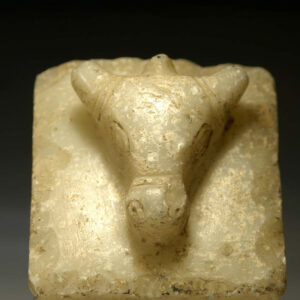
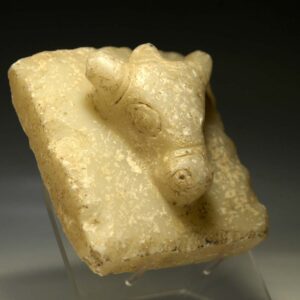
Sabaean Alabaster Relief

$4,000.00

This expertly carved alabaster relief, dating from approximately 300–100 BCE, depicts the commanding head of a bull, exemplifying the high level of artistry achieved by Sabaean sculptors. The broad forehead and prominent, outward-curving horns are rendered with meticulous precision, capturing the animal’s majestic presence. Carved with subtle incisions, the detailed facial features include expressive eyes that convey a sense of calm strength, along with alert ears that subtly indicate the bull’s awareness. The animal’s facial contours are skillfully emphasized, contrasting with the smooth, polished alabaster surface of the rectangular block.

The relief reflects the cultural reverence for bulls within Sabaean society, where such figures symbolized fertility, power, and divine authority. The preservation of fine detail and polished finish underscores its significance as both a religious and artistic object. This piece offers valuable insight into the spiritual and artistic traditions of the Sabaean civilization, standing as a striking testament to their craftsmanship and symbolic imagery.

REFERENCE #

SI_SA_1003

CIVILIZATION

Sabaean, 300 B.C.E. – 100 B.C.E.

SIZE

L. 11cm, W. 10cm

CONDITION

Some natural weathering, Fine condition

PRICE

$4000

PROVENANCE

The Baidun Collection. Purchased from the Jerusalem Local Market, 1980’s.

Silver Pair of Sphinx Handles

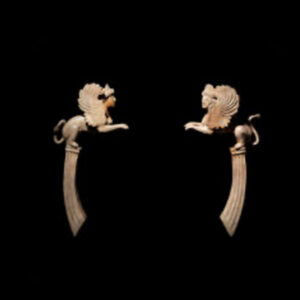
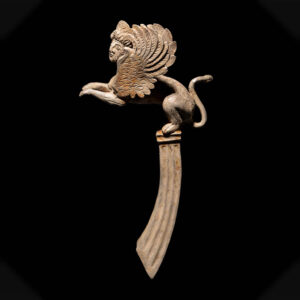
Two handles from a bowl, pot or goblet. The square section is hollow and convex in shape to make holding the vessel easier. Each handle terminates in a sphinx standing on its back legs, with its front paws outstretched. These would be the point where the handles were attached to the upper area of the vessel.

The sphinxes are identical apart from the fact that one head looks to the left and the other to the right, although not quite to the same degree. They are depicted according to the Greek social conception of this mythological creature. Each has the bust of a woman, the body and tail of a lion, great bird wings and a female human head. Each head is depicted wearing a diadem and with the hair swept up and held at the back of the head in a bun. The precision and detail of the working of the faces and wings is notable, giving a sense of movement and realism to the pair. One can appreciate a clear attempt to differentiate between the feathers of the wings: those inserted into the body itself are small and short, rather like scales, while those at the extreme end of the wings are long and narrow, to help the creature take flight.

According to ancient literary sources, the sphinx was a monster with the face and bust of a woman, the claws of a lion, the body of a dog, the tail of a snake and wings of a bird. This demon of divine origin, whose presence excited uncertainty and terror in humans, was also characterized by its pallid appearance, fiery look and venomous mouth. It’s possible that this hybrid had its origin in Egyptian iconography, where it was represented with a feline body and human face, possibly connected to the divine power of the pharaoh.

The sculptural prototype of Greek sphinxes appears around the 7th century BCE in terracotta and was usually found decorating large receptacles. A century later they appeared in marble crowning seated ex-votos on a column. The monstrous, aggressive nature of the hybrid was channelled into funerary art, serving as an apotropaic symbol to keep away malevolent forces. It was usual, therefore, to find this iconography in metopes and hollow acroteria in Greek necropoleis of the 6th century BCE, usually with the animal in profile and turning its head toward the public in an attitude of defiance.


Reference #

SI_GR_1034

Civilization Greek,

5th – 4th century B.C.E.

Size

H. 14 cm

Condition

Intact, Fine

Price

P.O.R.

Provenance

Private collection, Great Britain. Acquired before 1975


Trapezophoros Leg in the Form of a Lion

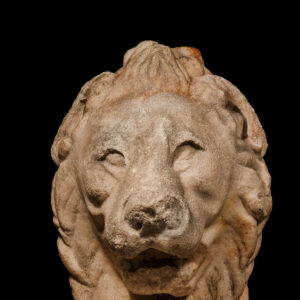
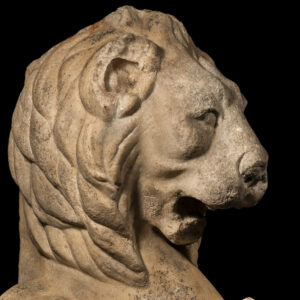
Table leg in the form of an upright lion. It’s back forms an S-shaped curve. The Jaws are wide open, revealing the canines and the tongue. The hair of the mane is arranged in regular tufts. Originally, acanthus leaves adorned it’s chest and sides. The reverse from the shoulders blades upward is flattened, forming a rectangular support. A circular drill hole between the shoulders to insert a horizontal bar supporting the table. On the top of the head, part of the pilaster on which the table top rested is missing. The lack of incised iris and pupil as well as the simple execution of the curls without drilling are indicative of an early date Drill holes on both sides of the lion’s chest where the acanthus emerge.

Reference: For the construction of a Roman table with trapezophoroi in the form of lions, cf. a marble table in the National Museum, Naples, in Richter – 1966, pl 577.

cf. two trapezophori in the Musei Vaticani in Rome, Arachne – 53732 and the Museum of Ancient Art Stockholm, Arachne – 130164

REFERENCE #

SI_RM_1082

CIVILIZATION

Roman, 100 C.E.

SIZE

H. 50 cm

CONDITION

Nose slightly worn, lower jaw and ears fragmentary. The rolled up leaf on the right largely preserved. The leaves on the chest and the left side missing. Preserved from the hips upward. Reassembled from two parts. Right hip slightly worn. Transition to foot preserved

PRICE

Price available upon request

PROVENANCE

English priv. collection 1940’s