Showing 65–71 of 71 results
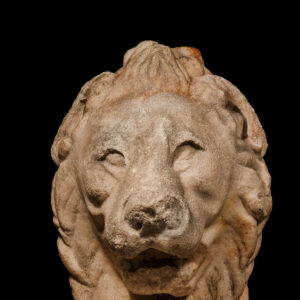
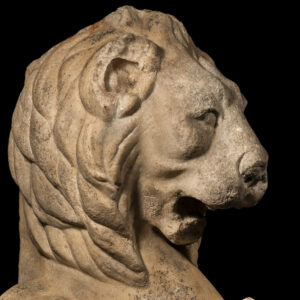
Trapezophoros Leg in the Form of a Lion
Table leg in the form of an upright lion. It’s back forms an S-shaped curve. The Jaws are wide open, revealing the canines and the tongue. The hair of the mane is arranged in regular tufts. Originally, acanthus leaves adorned it’s chest and sides. The reverse from the shoulders blades upward is flattened, forming a rectangular support. A circular drill hole between the shoulders to insert a horizontal bar supporting the table. On the top of the head, part of the pilaster on which the table top rested is missing. The lack of incised iris and pupil as well as the simple execution of the curls without drilling are indicative of an early date Drill holes on both sides of the lion’s chest where the acanthus emerge.
Reference: For the construction of a Roman table with trapezophoroi in the form of lions, cf. a marble table in the National Museum, Naples, in Richter – 1966, pl 577.
cf. two trapezophori in the Musei Vaticani in Rome, Arachne – 53732 and the Museum of Ancient Art Stockholm, Arachne – 130164
REFERENCE #
SI_RM_1082
CIVILIZATION
Roman, 100 C.E.
SIZE
H. 50 cm
CONDITION
Nose slightly worn, lower jaw and ears fragmentary. The rolled up leaf on the right largely preserved. The leaves on the chest and the left side missing. Preserved from the hips upward. Reassembled from two parts. Right hip slightly worn. Transition to foot preserved
PRICE
Price available upon request
PROVENANCE
English priv. collection 1940’s
Unrecorded Carolingian Commentary on Psalms
CAROLINGIAN COMMENTARY ON THE PSALMS, in Latin, two bifolia from a MANUSCRIPT ON VELLUM [Italy, 9th century] 280 x 380mm. 4 leaves (2 bifolia), ruled in blind, preserving most of two columns per page, each with 27 lines written in Carolingian minuscule in brown ink, numerous initials in two sizes in red (recovered from a binding, and thus very worn on one side of each bifolium, and with significant losses on three sides). In an archival folder. Provenance: Sotheby’s, 19 June 1990, lot 1. Legible passages of text consist of short phrases of Psalm 67: verses 6, 9-14, 16-17, 19, 22, and 25, presented as short lemmata interspersed by passages of commentary. The eight pages appear to be textually consecutive and would therefore originally have been the central two bifolia of their gathering. THE COMMENTARY IS THUS FAR UNIDENTIFIED, AND PERHAPS NOT PREVIOUSLY RECORDED. In the 9th century there were three main commentaries on the Psalms: Augustine’s Ennarationes in Psalmos, Cassiodorus’s Expositio Psalmorum, and Pseudo-Jerome’s Breviarium; the present fragment is none of these. Other much rarer ones were the Glossa ex traditionum seniorum, Bede’s Titulatio, and the commentary found in the Mondsee Psalter. See M. Gibson, ‘Carolingian Glossed Psalters’, in R. Gameson, ed., The Early Medieval Bible: Its Production, Decoration and Use, Cambridge, 1994, esp. pp.96
Reference #
MS_BZ_1002
Civilization
Byzantine
Size
L. 28 cm, W. 38 cm
Condition
Fine Condition
Price
Price available upon request
Provenance
Baidun Collection, Christies sale November 2013
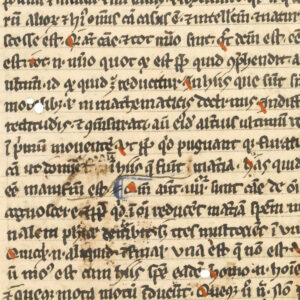
William Of Moerbeke’s Latin Translation Of Aristotle, Metaphysical
Three Leaves From A Decorated Manuscript On Vellum [Italy, Early Fourteenth Century]
3 leaves (a bifolium and a singleton), each 310mm. by 215mm., single column, 30 lines in black ink in a fine and professional university hand, capitals touched in red, paragraph marks alternately in red or blue, running titles in red “L[iber]” and “Phy[sica]” at head of each leaf, some early erasures and corrections, small flaws in vellum and occasional stains, else in fine condition.
Reference #
MS_BZ_1011
Civilization
Byzantine, Medieval, 1400 C.E.
Size
H. 31 cm x W. 21.5 cm
Condition
Some early erasures and corrections, small flaws in vellum and occasional stains, else in fine condition.
Price
Price available upon request
Provenance
Baidun Collection, acquired at Sotheby’s sale December 2013
Woven Cloth with Lion Frieze and Ornamental Bands
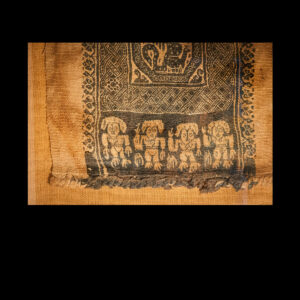
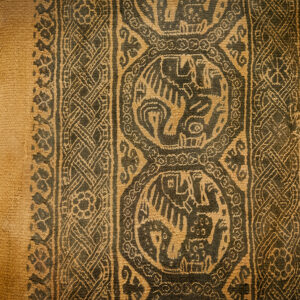
Important Woven Cloth with Lion Frieze and Ornamental Bands. Two-coloured tapestry weave in silhouette style, fine-threaded, dark grey and beige.
Rectangular length of cloth with centred vertical frieze of rampant lions with arching tails inside adjoining octagonal frames on a light-coloured ground, surrounded by a band of dense braiding with inside hatching alternating with flowers. Schematic palmettes in the spaces in between. Outer ornamental band of hanging rhombi. Lined up along the narrow edge at the bottom are four light-coloured, stocky human figures with bird’s feet, some with their left arm raised, set against a dark ground with fringed border below them. Fragment of a hanging
Sewn onto linen and framed. For style, ornamental structure and iconography, cf. Effenberger – 1976, 178, 216 f., 239, 270 f., pls. 119, 121, 125 (of later date, but with the same composition); Cat. Vienna – 2005, 155 f., no. 92 with illus.
REFERENCE #
TX_EG_1001
CIVILIZATION
Egypt, Coptic, 500 C.E. – 700 C.E.
SIZE
L. 99.2 cm, W. 26.5 cm
CONDITION
Fine Condition
PRICE
Price available upon request
PROVENANCE
Coll. A. and E. Offermann, Cologne (1965–2012). – Formerly private collection of Reichskanzler Franz von Papen (1879–1969), from June–December 1932 last but one Reichskanzler of the Weimar Republic, from January 1933 to July 1934 vice-chancellor in Hitler’s cabinet, later ambassador of the German Reich in Vienna and Ankara. Acquitted at the Nuremberg Trials of 1946, but one year later as one of the main culprits condemned to eight years in a labour camp as part of the denazification of Germany. Purchased in 2004 from Roswitha Eberwein, Antike Kunst, Göttingen. Declaration of provenance on back of frame: “Sammlung von Papen”.
Woven Fragment with Dancing Eros
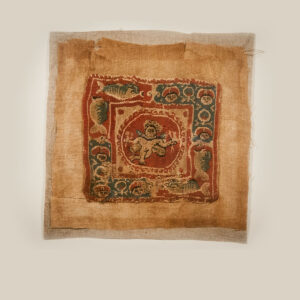
Woven Fragment with Dancing Eros (?) . Multi-coloured cloth in beige, green and red. Fine-threaded.
The tondo with “running dog” frame is set inside an almost square, red and green frame with an ornamental band composed of fishes and human heads. At its centre is a nude, wreathed figure with crotales, branches and wineskins.
Sewn onto beige linen and framed. Fragment of a tunic or tabula. – Cf. Cat. Leipzig – 2002, 66, 71 nos. 1, 15 with illus.
REFERENCE #
TX_EG_1003
CIVILIZATION
Egypt, Coptic, 400 C.E. – 600 C.E.
SIZE
L. 10 cm, W. 10 cm
CONDITION
Fine Condition
PRICE
Price
$2,000
PROVENANCE
Coll. A. and E. Offermann, Cologne (1965-2012). – Formerly Coll. Bareiss. Thereafter auction Neumeister, Munich, ca. 2009.
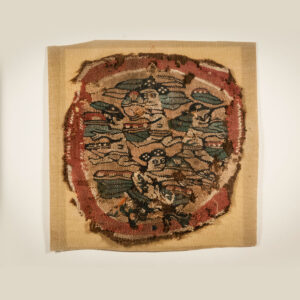
Woven Fragment with Running Figures
The tondo with beige ground and framed in red and white contains three figures running to the left and another at bottom running to the right, their heads in some cases turned back. Green foliage as ornamental filler between them
Sewn onto beige linen and framed. Fragment of a tunic or tabula. – For style, cf. Cat. New York-MET – 1977, 32 f., 43 nos. 29, 39 with illus.
TX_EG_1004
CIVILIZATION
Egypt, Coptic, 500 C.E. – 600 C.E.
SIZE
D. 15.8 cm
CONDITION
Fine Condition
PRICE
$2,000
PROVENANCE
Coll. A. and E. Offermann, Cologne (1965-2012). – Formerly Coll. Bareiss. Thereafter auction Neumeister, Munich, ca. 2009. Inv. no. “39/195236/12” on back of frame.