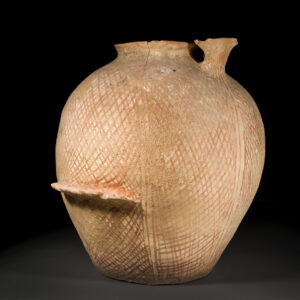
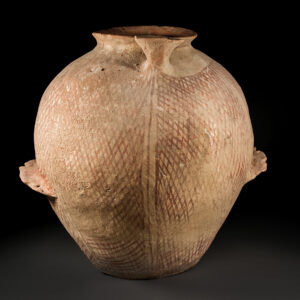
Large Canaanite Olive Oil Jar with a Dipper Holder

Large Canaanite chocolate and white ware, ancient Canaanite pottery corresponding to the Late Bronze Age of approximately 1530 B.C.E. – 1480 B.C.E. Narrow base rises to wide smooth shoulders, topped by slightly flared neck with straight-rimmed mouth. Monochrome paint patterns in four distinct rings on vase’s top half, interspersed with four stylized palm trees. Base structure of three loops, each painted with four short straight lines, serves as tripod stand.


REFERENCE #

KB_PT_2878

CIVILIZATION

Early Bronze Age I, 3500 B.C.E. – 3000 B.C.E.

SIZE

H. 34.5 cm

CONDITION

Fine condition

PRICE

Price available upon request

Leaf from an Illuminated Manuscript in Latin – Boethius, De Consolatione Philosophiae

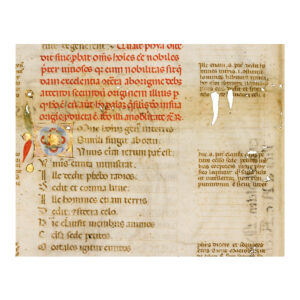
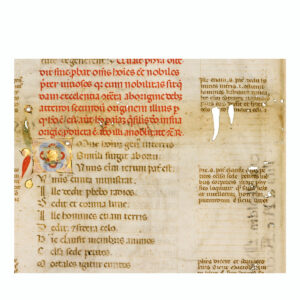
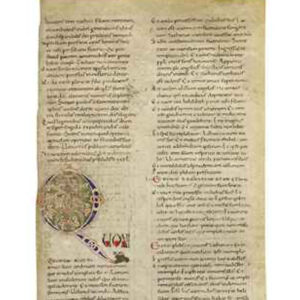
An Illuminated Manuscript On Vellum [Italy (Perhaps Florence), Fourteenth Century] a leaf, 315mm. by 230mm., 22 lines in a high grade angular bookhand, initials formed from ornamental penstrokes and separated from beginning of lines of verse, full border of the continuous gloss of the early fourteenth-century English author William Wheatley (see below) in smaller hand, rubrics and paragraph marks in red, two illuminated initials on blue or pink grounds with scrolling coloured acanthus leaves and large teardrop-like bezants, recovered from the binding of a series of Florentine historical works, partly by the Florentine humanist Matteo Palmieri, with sixteenth-century inscriptions identifying those works on its blank back, with scuffs, rubbing to initials, folds and small holes in places (with minor affect to 3 of glosses), overall in fair and presentable condition.

Reference #

MS_BZ_1010

Civilization

Byzantine, Medieval , 1400 C.E.

Size

H. 31.5 cm x W. 23 cm

Condition

Overall in fair and presentable condition

Price

Price available upon request

Provenance

Baidun Collection, acquired at Sotheby’s sale December 2013


Leaf from an Illuminated Manuscript in Latin – Boethius, De Consolatione Philosophiae

An Illuminated Manuscript On Vellum [Italy (Perhaps Florence), Fourteenth Century] a leaf, 315mm. by 230mm., 22 lines in a high grade angular bookhand, initials formed from ornamental penstrokes and separated from beginning of lines of verse, full border of the continuous gloss of the early fourteenth-century English author William Wheatley (see below) in smaller hand, rubrics and paragraph marks in red, two illuminated initials on blue or pink grounds with scrolling coloured acanthus leaves and large teardrop-like bezants, recovered from the binding of a series of Florentine historical works, partly by the Florentine humanist Matteo Palmieri, with sixteenth-century inscriptions identifying those works on its blank back, with scuffs, rubbing to initials, folds and small holes in places (with minor affect to 3 of glosses), overall in fair and presentable condition.

Reference #

MS_BZ_1010

Civilization

Byzantine, Medieval , 1400 C.E.

Size

H. 31.5 cm x W. 23 cm

Condition

Overall in fair and presentable condition

Price

Price available upon request

Provenance

Baidun Collection, acquired at Sotheby’s sale December 2013

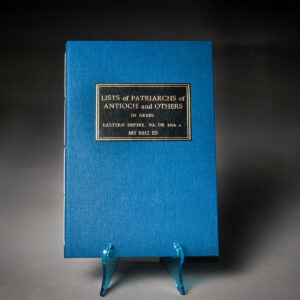
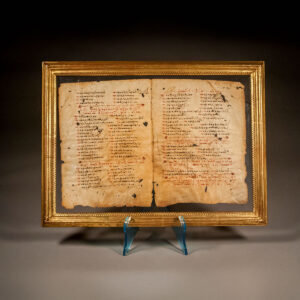
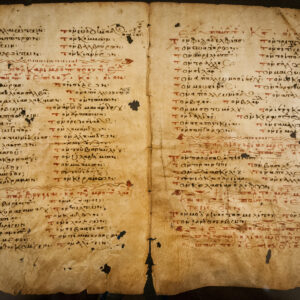
List of the Patriarchs of Antioch

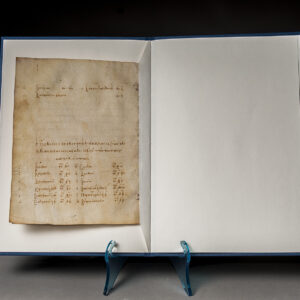
ANTIOCH preceded by the end of a list of the PATRIARCHS OF ALEXANDRIA and followed by a list of the canonical books of the Bible, in Greek, bifolium from a MANUSCRIPT ON VELLUM [Greece?, mid- to late- 10th century] 196 x 153mm. 17 lines ruled in blind written in brown ink in a fine and formal Greek minuscule, headings in uncials, modern foliation 46-47. In a modern cloth binding.

Provenance: (a) the conservative character of the writing is very marked, as is customary with the codices vetustissimi and vetusti of the 9th – 13th centuries. The minuscule slants slightly to the right, the breathings are square and the accents precise, and there is no enlargement of certain letters and intermixing with uncial forms as tends to happen in later centuries, all indicating a possible dating to the 10th century. The list of the Patriarchs of Alexandria ends with Peter IV (642-651), while the list of the Patriarchs of Antioch ends with Anastasius II (599-610), and the scribe has left space for 9 and 10 more names respectively, which would suggest he was copying the text from an earlier manuscript and writing a few centuries after the names listed. (b) ANDRe ROORYCK (1923-2010), sold at Sotheby’s, 5 July 2005, lot 7. An interesting and early bifolium from what would probably have been a compendium of useful religious dates, events, and lists relating to the Greek Orthodox Church. George I (621-630), Cyrus (631-641) and Peter IV (642-651) close the list of Patriarchs of Alexandria (following the Greek Orthodox as opposed to the Coptic Orthodox tradition, after the schism of 536), while the Patriarchs of Antioch run from Peter the Apostle (c.37 – 53) to Anastasius II (599-610).

Reference #

MS_BZ_1003

Civilization

Byzantine

Size

L. 19.6 cm, W. 15.3 cm

Condition

Fine Condition

Price

Price available upon request

Provenance

Baidun Collection

Martianus Capella, on the Marriage of Philology and Mercury in Latin

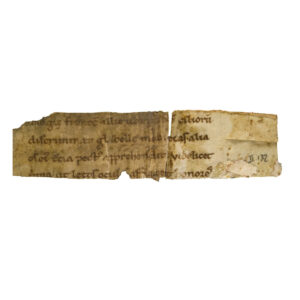
Manuscript Of The Text, In Latin, On Vellum [Germany, Early Twelfth Century] 9 fragments: 2 strips approximately 85mm. by 20mm. and 7 rectangular pieces, each approximately 42mm. by 25mm., one strip and one rectangle cut from same section of text allowing the reconstruction of 4 lines of a single column (35mm. wide): II:132-33, “Philologie frontem illuc ubi … oculis afflaret honores” and on back “sunt inclytam majestatem … hac regali lectica in”, and showing that the original volume was single-column and pocket-sized (with only approximately 21 lines missing between the lines here), other fragments with text from II:109, 110, 113, 130, and another part of 132, text in a fine late Carolingian hand with a pronounced ct-ligature, recovered from a binding of an sixteenth-century printed book from Leipzig, and hence with stains, cockling and splits.

Reference #

MS_BZ_1009

Civilization

Byzantine, Medieval , 1200 C.E.

Size

W. 8.5 cm, H. 2 cm

Condition

Fine condition

Price

Price available upon request

Provenance

Baidun Collection, acquired at Sotheby’s sale December 2013

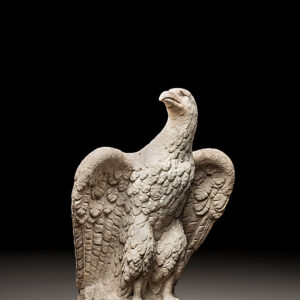
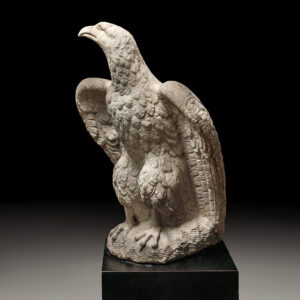
Monumental Imperial Roman Marble Eagle

Description

A large and imposing majestic Roman marble eagle, straight gaze, with its wings spread and legs bent preparing to take flight

REFERENCE #

SI_RM_1100

CIVILIZATION

Roman, 100 C.E. – 200 C.E.

SIZE

H. 64 cm

CONDITION

The beak is restored, otherwise in perfect condition.

PRICE

Price available upon request

PROVENANCE

French Private Collection purchased in Paris in the 1970’s.


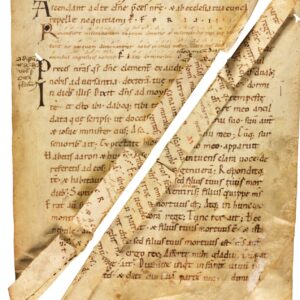
Nine Fragments From Early Liturgical Manuscripts

fragments: (i) 7 sections of leaves from a Missal, 5 triangular in shape (approximately 185mm. by 260mm.) and cut diagonally from the parent leaves, 2 further smaller pieces used as gathering supports (230mm. by 40mm. and 60mm. by 11mm.), the larger showing that the original codex was single column, 24 lines in light brown ink in a fine late Carolingian minuscule leaning to the right, with pronounced ct- and st-ligatures, lines of music in smaller script with simple neumes, rubrics (in ornamental capitals in style of ninth and tenth century) and simple red initials (some with tiny baubles at the head and foot), a few additions in later medieval hands including the apparent folio numbers “xxxi” and “xxxij” in late thirteenth-century script at the head of two leaves, Germany, second half of the eleventh century or c.1100; (ii) two long strips cut horizontally from a Lectionary leaf, each approximately 65mm. by 283mm., with remains of two columns of 7 lines of large and elegant early gothic script, rubrics and 17 one-line initials in red, Germany, mid-twelfth century; all recovered from bindings of early sixteenth-century books printed in Augsburg, and with some folds, scuffs, small stains and red ink oxidised to silver in places, but overall in good condition.

Reference #

MS_BZ_1012

Civilization

Byzantine, Medieval , 1100 C.E. – 1200 C.E.

Condition

Overall in good condition

Price

Price available upon request

Provenance

Baidun Collection, acquired at Sotheby’s sale December 2013


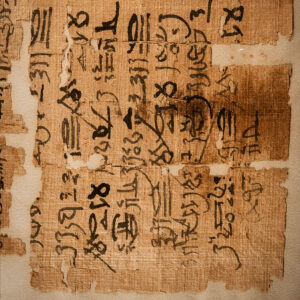
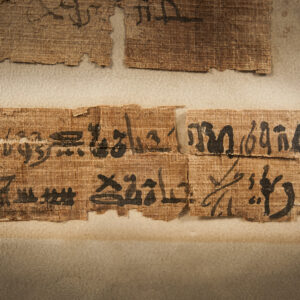
Papyrus Fragments of Egyptian Book of the Dead from Ptolemaic Period

Book of the Dead’ is a modern term for a collection of magical spells that the Egyptians used to help them get into the afterlife.  They imagined the afterlife as a kind of journey you had to make to get to paradise – but it was quite a hazardous journey so you’d need magical help along the way.

Prior to the New Kingdom, The Book of the Dead was only available to the royalty and the elite. The popularity of the Osiris Myth in the period of the New Kingdom made people believe the spells were indispensible because Osiris featured so prominently in the soul’s judgment in the afterlife. As more and more people desired their own Book of the Dead, scribes obliged them and the book became just another commodity produced for sale.

In the same way that publishers in the present day offer Print on Demand books or self-published works, the scribes offered different “packages” to clients to choose from. They could have as few or as many spells in their books as they could afford. Bunson writes, “The individual could decide the number of chapters to be included, the types of illustrations, and the quality of the papyrus used. The individual was limited only by his or her financial resources” (48).

From the New Kingdom through the Ptolemaic Dynasty (323 – 30 BCE) The Book of the Dead was produced this way. It continued to vary in form and size until c. 650 BCE when it was fixed at 190 uniform spells but, still, people could add or subtract what they wanted to from the text. A Book of the Dead from the Ptolemaic Dynasty which belonged to a woman named Tentruty had the text of The Lamentations of Isis and Nephthys attached to it which was never included as part of the Book of the Dead. Other copies of the book continued to be produced with more or less spells depending on what the buyer could afford. The one spell which every copy seems to have had, however, was Spell 125.

Featured here are several papyrus fragments of the Egyptian Book of the Dead from Egypt’s Ptolemaic Era (305 – 30 BCE).  Examining Egyptian art during these 300 years reveals strong continuities in its traditions but also interactions with Greek art, whose forms and styles swept the world with Alexander’s armies. The encounter of the two cultures had many aspects and phases, and is easiest to comprehend by looking first at the new ruling class, its involvements and concerns, and then at religion and the arts in the greater land of Egypt.


FOOTNOTES:
1.) The British Museum

2.) Ancient.eu

3.) Met Museum

REFERENCE #

MS_EG_1003


CIVILIZATION

Egyptian

SIZE

Varying…

CONDITION

Fine Condition

PRICE

Price upon request

PROVENANCE

Baidun Collection

Partial List of Eparchies in the Byzantine Church with Bishoprics in Asia Minor

Greek bifolium from the inside of a gathering with Greek foliation in a later hand, ff. 119, 120. Written on vellum in a small, neat minuscule hand in dark brown ink with section heading, initials, and ornamental penwork divisions in red. It does not appear to have been ruled.
Date: 11th century. See V. Gardthausen, Griechische Palæographie: Zweiter Band: Die Schrift, Unterschriften und Chronologie im Altertum und im byzantinischen Mittelalter, Zweite Auglage (Leipzig: Verlag von Veit & Comp., 1913), Taf. 7.
Provenance: This was formerly in the collection of late Professor David Bitzer of the Union Theological Seminary in Richmond, Virginia, According to De Ricci & Wilson he obtained it from the London dealer Leighton. The consignor was a descendant of Bitzer.
Contents:
The contents follow that of the edition of the Notitiæ by Darrouzès. The list for each eparchy has been supplied from a scanned image of his work in Notitia 1, 144-326, pp. 207-211.

Reference #

MS_BZ_1014

Civilization

Byzantine

Baidun Collection,

acquired at Christies sale November 2013

Condition

Fine condition

Price

Price available upon request

Provenance

Baidun Collection

Roman-Egyptian Schist Stone Head Bust of Greco-Egyptian god Zeus Serapis

Roman-Egyptian Schist Stone Head Bust of Greco-Egyptian god Zeus Serapis

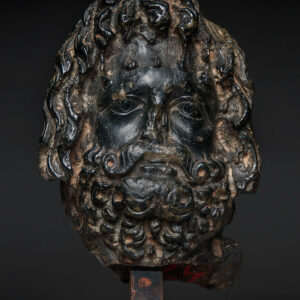
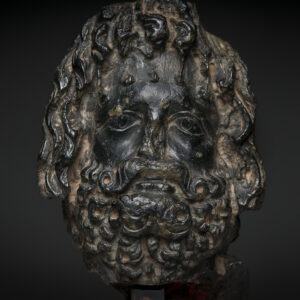
This Roman-Egyptian head bust of the Greco-Egyptian god Zeus Serapis is finely sculpted from black schist stone, and dates from the Roman-Egyptian Period, 100 C.E. – 200 C.E.  Representations of Serapis are uncommon.  The most famous representation of the deity is that by Bryaxis, the famous sculptor who is credited with creating the sculptures on the north side of the tomb of Maussollos – one of the wonders of the ancient world.  Other works of Bryaxis include a bronze statue of Seleucus, king of Syria, five huge statues at Rhodes, and a statue of Apollo at Daphne near Antioch.

The depiction of Serapis is uncommon, and this sculptor’s attention to detail is evident in all aspects of the piece:  Wavy hair locks flow elegantly down the back and sides of Serapis’ head, as hair bangs drape across his forehead.  His thick, full beard of curly hair locks covers his face in the classic style of ancient Greece which regarded the beard as a badge or sign of virility; Greek beards were also frequently curled with tongs.

Even though from the earliest times in ancient Greece the shaving of the upper lip was not uncommon, here Serapis is depicted with full handlebar mustache which curls upward on both sides of his face, revealing only his bottom lip.  The superb craftsmanship of this piece is manifest down to the finest details in Serapis’ eyes which reveal the corneas that are clearly distinguishable from the sclera of each eye, and each is accentuated by delicate, finely-crafted eyelids as well as with expressive, arched eyebrows which are visible under the hair bangs.

Some of these hair locks that cover the forehead are missing, as well as part of the nose which were broken in antiquity.  The cult of Serapis was banned in 391 C.E. and many of the sculptures destroyed.  Therefore this fine specimen is an uncommon example that has survived the ravages of history, and thus is a very notable piece of rare ancient art.


The Cult of Serapis / Sarapis

The cult of Serapis was introduced during the 3rd century B.C.E. on the orders of Ptolemy I of Egypt as a means to unify the Greeks and Egyptians in his realm.  Sarapis was a syncretistic deity derived from the worship of the Egyptian Osiris and Apis (Osiris + Apis = Oserapis/Sarapis).

Serapis also gained attributes from other deities, such as chthonic powers linked to the Greek Hades and Demeter, as well as benevolence linked to Dionysus.  However, although he was identified with various Greek gods, Serapis was above all – because of his authority and his association with rulers (the Ptolemies in this case) – identified with Zeus.

Ptolemy I Soter (r. 305–284 B.C.E) commissioned the syncretistic god Serapis in order that the native population of Egypt – who already had an extensive pantheon of deities – and the occupying forces of Greece could have a common ritual focus, and he centered the worship of the deity at Alexandria.  Serapis (or Sarapis) was a Greco-Egyptian deity of the Sun first encountered at Memphis where his cult was celebrated in association with that of the sacred Egyptian bull Apis (who was called Osorapis when deceased).  The god therefore shared a group of attributes common to Greeks (physically robust, bearded male) and to Egyptians (attire and accessories).  He was originally shown seated, with a sceptre of power, wearing a grain measure on his head, accompanied by a snake (identified with the Egyptian royal uraeus) and with a dog (originally held to be Anubis, later Cerberus) by his side.


Sources:

1.) Art Fund – Bust of Zeus Serapis by Greek

2.) Met Museum – Gold statuette of Zeus Serapis

3.) Britannica – Serapis

4.) Britannica – Apis

5.) Britannica – Ptolemy I Soter

6.) Wikipedia – Serapis or Sarapis

7.) Wikipedia – Beards in Ancient Greece

8.) Wikipedia – Bryaxis

9.) University of Chicago – The Temple of Serapis at Alexandria

10.) Book – “Zeus” by Ken Dowden[/vc_column_text]

REFERENCE #

SI_RM_1099

CIVILIZATION

Roman-Egyptian Period, 100 C.E. – 200 C.E.

SIZE

H. 11.4 cm

CONDITION

Fine condition, some of the hair locks from the forehead are missing.

PRICE

$23,000

PROVENANCE

Ex French private collection, acquired 1975.

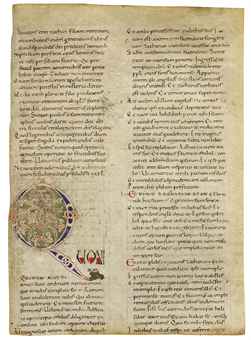
ROMANESQUE INITIAL ‘Q’ on a Leaf from a Monumental Bible

The initial in white, yellow, and blue, the shape of the ‘Q’ formed by an elaborate interlace pattern of white-vine scroll outlined in red, the infill with stylised foliage against a ground of green, 45 lines of text written in a handsome rounded protogothic transitional script in two columns, incipits in uncials touched red, initials in red (approximately 50 words, or 10 lines, trimmed from the bottom of each column, verso with adhesive stains to upper margin, not affecting the text). In a modern cloth binding. The recto opens with the end of thestandard Lucan prologue and continues with the beginning of Luke’s Gospel (Luke 1:1-25) — ‘Quoniam quidam multi conati sunt’; the verso continues with Luke 1:29-76. The layout of the text is unusual and interesting: verse 1 is here treated as the start of the book; often verses 1-4, the Dedication to Theophilus, are treated as a prologue, and verse 5 as the start of the Gospel proper. Both theMagnificat and the Benedictus, two of the six biblical canticles that were sung every week in all monasteries, are here written with enlarged red initials, their incipits in rustic capitals touched with red dots, and with left-justified red initials at the start of each phrase. The first lines of verses 18, 56, and 57 are treated similarly. The abstract, stylised design of the initial, with its intricate white-vine pattern and stark palette of primary colours testifies to the influence in Romanesque decoration of pre-Christian ornamental traditions. The fine example in the present leaf is closely reminiscent of an initial ‘A’ cut from another Romanesque bible, now at the Free Library in Philadelphia (Lewis E M 16:10)

Reference #

MS_BZ_1004

Civilization

Byzantine

Size

L. 38.2 cm , W. 27 cm

Condition

Fine Condition

Price

Price available upon request

Provenance

Baidun Collection

ROMANESQUE INITIAL ‘Q’ on a Leaf from a Monumental Bible

The initial in white, yellow, and blue, the shape of the ‘Q’ formed by an elaborate interlace pattern of white-vine scroll outlined in red, the infill with stylised foliage against a ground of green, 45 lines of text written in a handsome rounded protogothic transitional script in two columns, incipits in uncials touched red, initials in red (approximately 50 words, or 10 lines, trimmed from the bottom of each column, verso with adhesive stains to upper margin, not affecting the text). In a modern cloth binding. The recto opens with the end of thestandard Lucan prologue and continues with the beginning of Luke’s Gospel (Luke 1:1-25) — ‘Quoniam quidam multi conati sunt’; the verso continues with Luke 1:29-76. The layout of the text is unusual and interesting: verse 1 is here treated as the start of the book; often verses 1-4, the Dedication to Theophilus, are treated as a prologue, and verse 5 as the start of the Gospel proper. Both theMagnificat and the Benedictus, two of the six biblical canticles that were sung every week in all monasteries, are here written with enlarged red initials, their incipits in rustic capitals touched with red dots, and with left-justified red initials at the start of each phrase. The first lines of verses 18, 56, and 57 are treated similarly. The abstract, stylised design of the initial, with its intricate white-vine pattern and stark palette of primary colours testifies to the influence in Romanesque decoration of pre-Christian ornamental traditions. The fine example in the present leaf is closely reminiscent of an initial ‘A’ cut from another Romanesque bible, now at the Free Library in Philadelphia (Lewis E M 16:10)

Reference #

MS_BZ_1004

Civilization

Byzantine

Size

L. 38.2 cm , W. 27 cm

Condition

Fine Condition

Price

Price available upon request

Provenance

Baidun Collection

Sabaean Alabaster Relief

$4,000.00

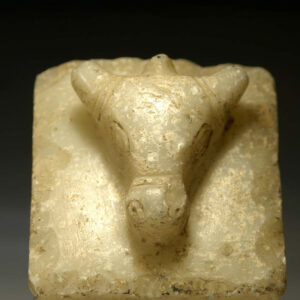
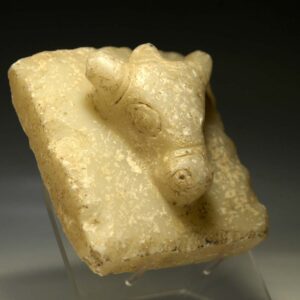
This expertly carved alabaster relief, dating from approximately 300–100 BCE, depicts the commanding head of a bull, exemplifying the high level of artistry achieved by Sabaean sculptors. The broad forehead and prominent, outward-curving horns are rendered with meticulous precision, capturing the animal’s majestic presence. Carved with subtle incisions, the detailed facial features include expressive eyes that convey a sense of calm strength, along with alert ears that subtly indicate the bull’s awareness. The animal’s facial contours are skillfully emphasized, contrasting with the smooth, polished alabaster surface of the rectangular block.

The relief reflects the cultural reverence for bulls within Sabaean society, where such figures symbolized fertility, power, and divine authority. The preservation of fine detail and polished finish underscores its significance as both a religious and artistic object. This piece offers valuable insight into the spiritual and artistic traditions of the Sabaean civilization, standing as a striking testament to their craftsmanship and symbolic imagery.

REFERENCE #

SI_SA_1003

CIVILIZATION

Sabaean, 300 B.C.E. – 100 B.C.E.

SIZE

L. 11cm, W. 10cm

CONDITION

Some natural weathering, Fine condition

PRICE

$4000

PROVENANCE

The Baidun Collection. Purchased from the Jerusalem Local Market, 1980’s.

Silver Pair of Sphinx Handles

Two handles from a bowl, pot or goblet. The square section is hollow and convex in shape to make holding the vessel easier. Each handle terminates in a sphinx standing on its back legs, with its front paws outstretched. These would be the point where the handles were attached to the upper area of the vessel.

The sphinxes are identical apart from the fact that one head looks to the left and the other to the right, although not quite to the same degree. They are depicted according to the Greek social conception of this mythological creature. Each has the bust of a woman, the body and tail of a lion, great bird wings and a female human head. Each head is depicted wearing a diadem and with the hair swept up and held at the back of the head in a bun. The precision and detail of the working of the faces and wings is notable, giving a sense of movement and realism to the pair. One can appreciate a clear attempt to differentiate between the feathers of the wings: those inserted into the body itself are small and short, rather like scales, while those at the extreme end of the wings are long and narrow, to help the creature take flight.

According to ancient literary sources, the sphinx was a monster with the face and bust of a woman, the claws of a lion, the body of a dog, the tail of a snake and wings of a bird. This demon of divine origin, whose presence excited uncertainty and terror in humans, was also characterized by its pallid appearance, fiery look and venomous mouth. It’s possible that this hybrid had its origin in Egyptian iconography, where it was represented with a feline body and human face, possibly connected to the divine power of the pharaoh.

The sculptural prototype of Greek sphinxes appears around the 7th century BCE in terracotta and was usually found decorating large receptacles. A century later they appeared in marble crowning seated ex-votos on a column. The monstrous, aggressive nature of the hybrid was channelled into funerary art, serving as an apotropaic symbol to keep away malevolent forces. It was usual, therefore, to find this iconography in metopes and hollow acroteria in Greek necropoleis of the 6th century BCE, usually with the animal in profile and turning its head toward the public in an attitude of defiance.


Reference #

SI_GR_1034

Civilization Greek,

5th – 4th century B.C.E.

Size

H. 14 cm

Condition

Intact, Fine

Price

P.O.R.

Provenance

Private collection, Great Britain. Acquired before 1975