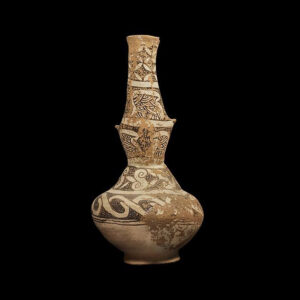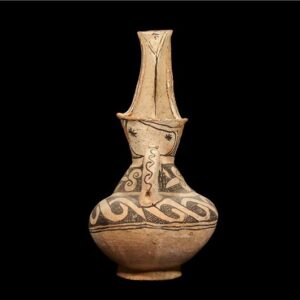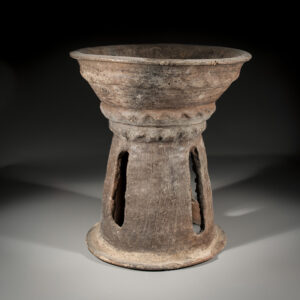
Ceramic Fenestrated Ceremonial Stand
A ceramic fenestrated ceremonial stand
REFERENCE #
KB_PT_0040
CIVILIZATION
Chalcolithic Period, 4000 B.C.E. – 3500 B.C.E.
SIZE
H. 27 cm
CONDITION
Fine condition
PRICE
Price available upon request

Showing 33–48 of 72 results
A ceramic fenestrated ceremonial stand
KB_PT_0040
Chalcolithic Period, 4000 B.C.E. – 3500 B.C.E.
H. 27 cm
Fine condition
Price available upon request
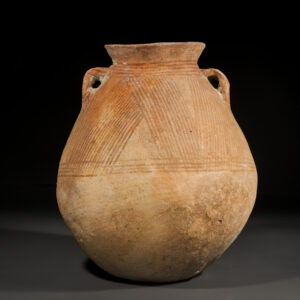
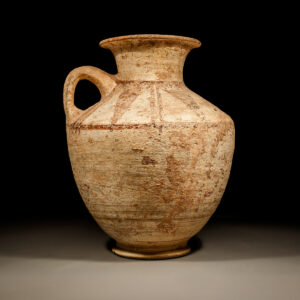
The thin lines that mark the top half of this large amphoriskos are on the primal end of art history, yet their application is so intricate as to reveal the care and attention to detail of the Canaanite artisan who applied them to the vessel’s exterior over 5000 years ago.
The large egg-shaped body of this amphoriskos allowed it to hold substantial amounts of liquid, be it wine, water or oil. The rich desert tones of its smooth exterior stand out boldly among the monochrome paint that scratch its surface.
KB_PT_2510
Early Bronze Age, 3500 B.C.E. – 3000 B.C.E.
H. 20 cm
Fine condition
Price available upon request
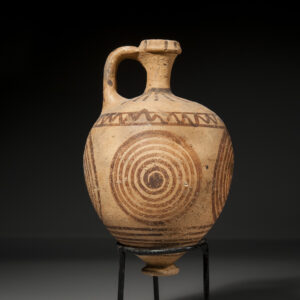
A classic Canaanite Levantine periform painted ware juglet[/vc_column_text]
KB_PT_0053
Middle Bronze Age II A, 1800 B.C.E. – 1700 B.C.E.
H. 13.5 cm
Excellent condition
Price available upon request
‘Book of the Dead’ is a modern term for a collection of magical spells that the Egyptians used to help them get into the afterlife. They imagined the afterlife as a kind of journey you had to make to get to paradise – but it was quite a hazardous journey so you’d need magical help along the way.
Prior to the New Kingdom, The Book of the Dead was only available to the royalty and the elite. The popularity of the Osiris Myth in the period of the New Kingdom made people believe the spells were indispensible because Osiris featured so prominently in the soul’s judgment in the afterlife. As more and more people desired their own Book of the Dead, scribes obliged them and the book became just another commodity produced for sale.
From the New Kingdom through the Ptolemaic Dynasty (323 – 30 BCE) The Book of the Dead was produced this way. It continued to vary in form and size until c. 650 BCE when it was fixed at 190 uniform spells but, still, people could add or subtract what they wanted to from the text. A Book of the Dead from the Ptolemaic Dynasty which belonged to a woman named Tentruty had the text of The Lamentations of Isis and Nephthys attached to it which was never included as part of the Book of the Dead. Other copies of the book continued to be produced with more or less spells depending on what the buyer could afford. The one spell which every copy seems to have had, however, was Spell 125.
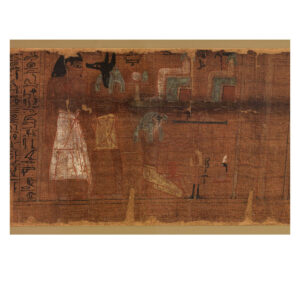
Featured here are two papyrus fragments from the Egyptian New Kingdom, 18th Dynasty (circa 1400 BCE) of an Egyptian Book of the Dead written for the Royal sandal-bearer of Isis, Min-Her-Khetiu:
The smaller papyrus sheet includes the painted figures of a woman and the dead man, their hands raised in adoration. Between them a column of hieroglyphs gives the name and title of the owner. Seven columns of hieroglyphs in the center contain the opening of Chapter 7 headed ‘Chapter of Sailing in the Bark of Ra’. Above this an accompanying vignette of a shallow boat containing the falcon headed Ra crowned with solar disc and flanked by wedjat eyes to signify health and security. To the right four columns recounting part of Chapter 149,’The Fourteen Mounds’, the illustration above showing a pottery jar with liquid spilling from it.
The longer sheet carries thirty columns of Chapter 125 ‘The Declaration of Innocence’ with a scene showing standing figures of Anubis with the dead man to the left of a kneeling falcon headed god (Horus though he is labelled Thoth) supervising the weighing of the heart against Maat. Two seated gods above the scales represent the 42 gods who witness the judgement. Two of the three columns in the center are from Chapter 81a ‘Spell for becoming a lotus’ and on the right side of the sheet are ten columns from the beginning of Chapter 144 ‘Address to the Keepers of the Underworld’ with the paired figures of the horned guardian and reporter of each gate shown at the foot of the column.
Other fragments from the same scroll can be found in the Cairo Museum and the Papyrus Museum, Syracuse, Italy. This piece is the oldest illuminated manuscript of the Egyptian Book of the Dead in private hands, and among the oldest literary manuscripts (MSS) on papyrus.
Previously Maurice Nahman, Cairo, acquired 1930s; The Schøyen Collection, Norway.
Kon-Tiki Museet, Oslo, 2002-3
Barbara Lüscher, ‘Der Totenbuch- Papyrus des Minherchetiu‘ in Studien zur Altägyptishen Kultur, Band 36, 2006.
#SC_EG_1001
New Kingdom. 18th Dynasty, c.1400 B.C.E.
H. 14 x L. 33.2 cm and H. 15.5 x L. 88.8 cm
Fine condition
Available Upon Request
Maurice Nahman, Cairo, acquired 1930s; The Schøyen Collection, Norway. Exhibited: Kon-Tiki Museet, Oslo, 2002-3 Literature: Published: Barbara Lüscher, ‘Der Totenbuch- Papyrus des Minherchetiu’ in Studien zur Altägyptishen Kultur, Band 36, 2006.
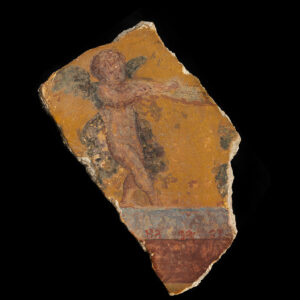
A fragment from a frieze depicting Eros as a winged child pulling on one end of a swag or garland. He is depicted naked apart from a cloak that hangs from his shoulders and behind his body, visible flapping loosely on either side of his legs. The fluttering ends of a cloak belonging to a second figure, presumably another Eros or possibly a Psyche, can be seen on the right. Painted on an ochre background with remains of two bands below of sky blue and terracotta. The edge of a lower register visible.
SI_RM_1094
Roman, 100 C.E.
H. 27.5 cm x W. 15 cm
Fine condition
Price upon request
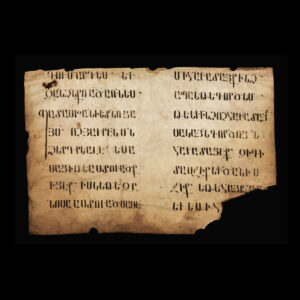
Four leaves from an extremely early Biblical codex. 4 leaves, with one complete leaf and a lower half (bisected horizontally across the page) from an early Armenian translation of John 10-11, the complete leaf 320mm. by 230mm., double column, 17 lines in dark brown ink in large and imposing erkat’agir majuscules (the so-called ‘Iron Writing’, the earliest Armenian script to survive in manuscript) with capitals with long trailing descenders, notably similar to British Library, Add. MS.21932, trimmed to edges of text, Armenia, probably ninth or tenth century; plus the lower half of a leaf from a Biblical or liturgical manuscript, 200mm. by 135mm., with remains of double column, 12 lines in light brown ink in a smaller and squarer hand closer to that of Dublin, Chester Beatty MSS.554 and 556, both twelfth century (Catalogue of the Armenian Manuscripts, 1958 II: pls.1 and 4), Armenia, probably twelfth century; all leaves recovered from bindings and with stains, tears, folds and later pen-trials and notes, but overall in fair and sound condition.
This is an extremely early and important witness to the Gospel of Mark, written within decades of the death of Jerome and Augustine of Hippo; it is perhaps from the Imperial library of Constantinople, the last of the great libraries of the ancient world This manuscript is from an important cache of early fragments, discovered in 2003, and reported to have been from a pre-War Armenian collection of antiquities and manuscripts in France. Five Biblical fragments, including the present one, were published by P.M. Head in the Journal of Theological Studies, ns.59 (2008), with short earlier notices in TC: A Journal of Biblical Textual Criticism, 8 (2003), Bulletin of the International Organization for Septuagint and Cognate Studies, 36 (2003) and the Tyndale Bulletin, 56 (2005). They include fragments of Luke (fifth century, and probably the oldest witness to that part of the text), John (late fifth century or even c.500), another fragment of Mark (fifth to sixth century) and Romans (sixth or seventh century). Subsequently, the other fragments have been identified as the oldest extant witness to the Lucianic recension of Jeremiah in Greek (early to mid-fifth century: Head ibid., pp.1-11), the only surviving witness to the Greek original text of the Testamentum Domini Nostri Jesu Christi (fifth century: Corcoran and Salway in Journal of Theological Studies, ns.62 (2011) pp.118-35), and the only surviving fragments of a series of imperial edicts made by third-century emperors and now named the Fragmenta Londiniensia Anteiustiniana (fifth century: Corcoran and Salway in Zeitschrift der Savigny Stiftung für Rechtsgeschichte: romanistische Abteilung, 127 (2010) pp.677-8, and Roman Legal Tradition, 6 (2010). Clearly these fragments of six early Bibles, a pseudo-Apostolic Church Order, and records of imperial edicts were once in a large and important library of the ancient world, in scope and chronological range far beyond that of a wealthy individual. There were large institutional libraries in Upper Egypt (such as that of the monastery founded by Pachomius c.320), Roman North Africa (as used by Augustine of Hippo in the late fourth and early fifth century), Milan (as used by Ambrose in the late fourth century) and Alexandria (as used by Bishop Gregory of Alexandria in the mid-fourth century), but the Eastern Empire was increasingly centred on Constantinople as its outlying territories fell prey to barbarian invasion. Jerome notes that the Lucianic recension of the Septuagint (including the fragment of Jeremiah noted above) was current only in Constantinople and Antioch in the early fifth century, and the collection of imperial edicts has been tentatively identified as also coming from the city. If so, it seems likely that they come from the Imperial Library in Constantinople, founded by Emperor Constantius II (reigned 337-61) as a scriptorium with the express purpose of copying fragile papyrus documents onto more stable vellum. Under Emperor Valens in 372 it employed four Greek and three Latin scribes. It survived a fire in 473, was sacked by the Normans in 1204 during the Fourth Crusade, and eventually destroyed only after the conquest of the city by the Ottoman Empire in 1453. The only other manuscript thought to be from this source is that of the Archimedes Palimpsest, which surfaced first in Constantinople in 1840 and is now in a private collection in America.
Reference #
MS_BZ_1006
Byzantine
W. 10 cm, H. 2 cm
Fine Condition
SOLD
According to ancient literary sources, the sphinx was a monster with the face and bust of a woman, the talons of a lion, the body of a dog, a serpent’s tail and wings of a bird. Its pale appearance, venomous mouth and stony gaze characterised this demon of divine origin. Its presence amongst humans created uncertainty and fear. It is possible that this hybrid had its origin in Egyptian iconography, where it was represented with the body of a feline and a human face, and was probably related to the divine power of the pharaoh.
This terracotta piece shows a monster seated on its haunches and in profile, with its head turned to the right toward the public. The female countenance has idealised features of great beauty. The thick, wavy hair is crowned with a polos or crown on the Corinthian model. On the right wing the rendering of the feathers shows a clear interest in the anatomical details of birds: the feathers inserted into the body itself are small and short, rather like scales, while those at the extreme end of the wing are long and narrow, to help the bird take flight.
The sculptural prototype of Greek sphinxes appears around the 7th century BC in terracotta, and was usually found decorating large receptacles. A century later they appeared in marble crowning seated ex-votos on a column. The monstrous, aggressive nature of the hybrid was channelled into funerary art, serving as an apotropaic symbol to keep away malevolent forces. It was usual, therefore, to find this iconography in metopes and hollow acroteria in Greek necropoleis of the 6th century BC, usually with the animal in profile and turning its head toward the public in an attitude of defiance.
BIBLIOGRAPHY:
SI_GR_1034
Size
Condition
In a good state of preservation, without any restoration.
Private collection G. A., Gardena, California, USA.
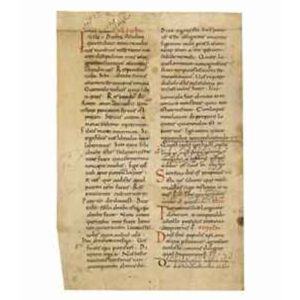
7 leaves and one part-leaf, 312 x 215mm — 372 x 265mm: (i) ORIGEN (d.253/4), translated by RUFINUS (d.410), In Numeros Homiliae, in Latin, [Italy, perhaps Tuscany, early 12th century], 2 almost complete leaves, two columns of 34 lines written in a fine rounded Carolingian minuscule bookhand in dark brown ink, the text containing parts of Homily XXVI and XXVII, with a December 1580 inscription in Italian on f.1v, 372 x 265mm; A MISSAL, in Latin, [Italy, probably Tuscany, early 13th century], 2 leaves, two columns of 31 lines written in brown ink, rubrics and initials in red, the text from the Sanctoral containing masses for Saints Zenobius, Romulus, Reparata and Cerbonius, all Tuscan, 311 x 215mm; ROLANDINUS RODOLPHINUS (d.1300), Summa artis notariae, in Latin, [Italy, late 13th or early 14th century], 1 leaf and one part leaf, two columns of 44 lines written in brown ink, rubrics and paraphs in red, the text containing parts of chapters VIII and IX, 320 x 223mm; A BREVIARY, in Latin, [Italy, late 14th century], two leaves, two columns of at least 23 lines, initials in red and blue, rubrics in red, with part of the text for Feria VI in Easter week, ownership inscriptions in Italian, 355 x 275mm (all recovered from bindings, some cropping, staining and creasing). All in modern card bindings.
Reference #
MS_BZ_1005
Medieval , 1200 C.E. – 1400 C.E.
7 leaves and one part-leaf, 312 x 215mm — 372 x 265mm
Fine Condition
Price available upon request
Baidun Collection, acquired at Christies sale November 2013
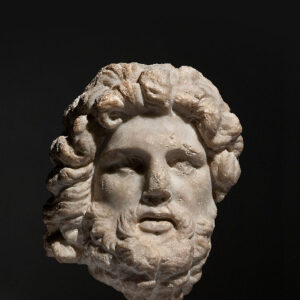
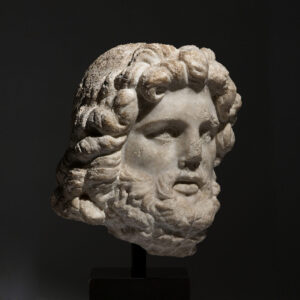
Zeus’ imposing presence was felt throughout Ancient Greece as evidenced by the many sculptures and paintings of his image that make up the region’s archaeological record. This white marble sculpture of Zeus dates from Greece’s Hellenistic period of approximately 300-200 B.C.E., a time when Greek sculpture had entered a Classical period defined by its rigid poses and severe features. This figure’s lush hair, parted lips, and strong brow show the emphasis placed on such stylized details during Greece’s Classical period.
This sculpture is a highly realistic representation of Zeus, and it may be that the sculptor based this image on someone he knew from his everyday life. This sculpture is a breathtaking example of the technical skill and detailed eye of Greece’s celebrated sculptors. The piece has been restored to reveal the sculpture’s original power, although the body has been lost to history’s vagaries.
SI_GR_1011
Greek Hellenistic, 300 B.C.E. – 200 B.C.E.
H. 30 cm
Fine condition
P.O.R
English Private Collection of a German Professor, ca 1970’s
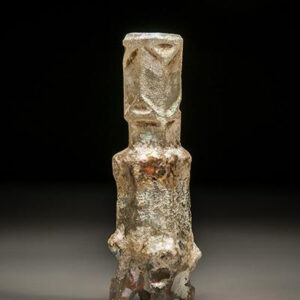
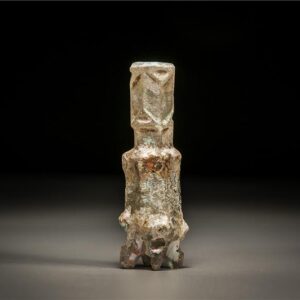
Colorless, bubbly/mold-blown. Ground rim, neck narrowing toward bottom, square body, which at the bottom part divides into four cut wedge-shaped feet arranged around a flat bottom. The Molar bottle is a characteristic example of cut Islamic glass. Its name derives from the four wedge-shaped feet, which resemble the root of a molar tooth. In Lamm’s opinion, such bottles were manufactured in Egypt, from where they were distributed throughout the Islamic world as perfume containers. Similar bottles were also fashioned from metal and ivory. They were common in the 900 and 1000 AD, but thereafter their production was ceased. They have been found in Iraq, Iran, Egypt, Syria and the holy land.
GL_IS_1001
Islamic, 900 C.E. -1000 C.E.
H. 7.5 cm
Fine condition
Price available upon request
The Baidun Collection
This ewer is from the reign of the Ayyubid dynasty that ruled much of the Middle East for over a century starting in approximately 1100 C.E.. The Ayybuids were Islamic warriors who conquered parts of Egypt, Syria, northern Mesoptamia, the Kingdom of Jerusalem and the southwestern swath of the Arabian Peninsula. In such a region, water was essential in daily life, and the cool relief that this ewer brought was not lost on those who received a glass from its long spout.
This ewer is of a recognizable shape, although the elongated mouth and the three careful holes at the neck’s top show how water was guarded preciously from being wasted in the desert. We see distinct Islamic designs that closely resemble the fluid movement of Arabic calligraphy. The crude craftsmanship gives way to the ewer’s brilliant front, designed with such intricate lines and patterns so as to lift this everyday object up beyond the everyday into a truly beautiful piece of antiquity. The ewer dates from approximately 1000 C.E. – 1200 C.E. and is 28 cm in height.
CR_IS_1002
Islamic, 1000 C.E. – 1200 C.E.
H. 28 cm
Fine condition
Sold
The Baidun Collection
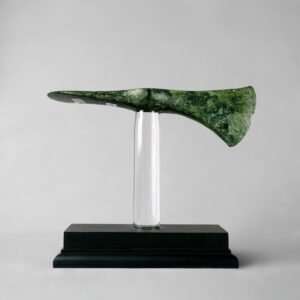
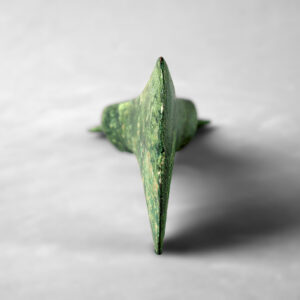
A cast bronze axe head with a cylindrical socketing shaft, a tapered spike on the back end, and a horizontal axe blade on the front.
For similar see: Nikolaus Boroffka, Simple technology. Casting moulds for axe-heads. In: Tobias L. Kienlin, Ben Roberts (ed.), Metals and society. Studies in honour of Barbara S. Ottaway.
Universitätsforschungen zur Prähistorischen Archäologie 169. Vertag
Dr. Rudolf Habelt GmbH (Bonn 2009), pp. 246-257, n. 1-2.
REFERENCE #
WP_PR_1115
Canaanite, 1200 B.C.E. – 800 B.C.E.
Time of the Israelite Kingdom
L. 20 cm
Fine condition
$2500
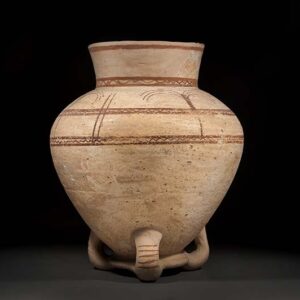
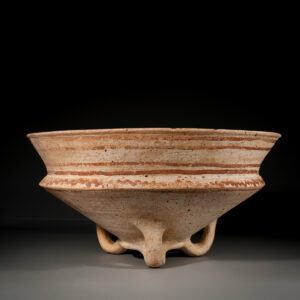
Large Canaanite chocolate and white ware, ancient Canaanite pottery corresponding to the Late Bronze Age of approximately 1530 B.C.E. – 1480 B.C.E.. Narrow base rises to wide smooth shoulders, topped by slightly flared neck with straight-rimmed mouth. Monochrome paint patterns in four distinct rings on vase’s top half, interspersed with four stylized palm trees. Base structure of three loops, each painted with four short straight lines, serves as tripod stand.
KB_PT_9984
Late Bronze Age IA, 1530 B.C.E. – 1480 B.C.E.
H. 26 cm
Fine condition
Price available upon request
A large Canaanite chocolate and white ware jug
KB_PT_9984
Late Bronze Age IA, 1530 B.C.E. – 1480 B.C.E.
H. 26 cm
Fine condition
Price available upon request
A large Canaanite chocolate on white ware, loop footed krater