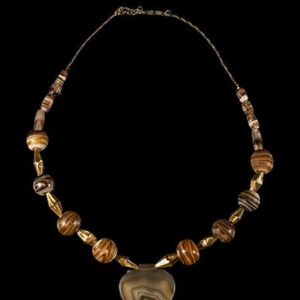
Banded Agate Necklace with 22K Gold Inserts

A very beautiful Byzantine banded multi shaped Agate beads necklace with 22K gold leaf covered diamond shaped inserts

REFERENCE #

JW_RM_1018

CIVILIZATION

Byzantine Period, 600 C.E. – 700 C.E.

SIZE

L. 47 cm

CONDITION

Excellent condition

PRICE

$2500

PROVENANCE

The Baidun Collection

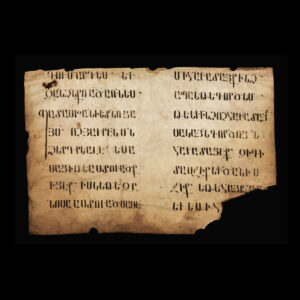
Gospel of John, in Armenian

Four leaves from an extremely early Biblical codex.  4 leaves, with one complete leaf and a lower half (bisected horizontally across the page) from an early Armenian translation of John 10-11, the complete leaf 320mm. by 230mm., double column, 17 lines in dark brown ink in large  and imposing erkat’agir majuscules (the so-called ‘Iron Writing’, the earliest Armenian script to survive in manuscript) with capitals with long trailing descenders, notably similar to British Library, Add. MS.21932, trimmed to edges of text, Armenia, probably ninth or tenth century; plus the lower half of a leaf from a Biblical or liturgical manuscript, 200mm. by 135mm., with remains of double column, 12 lines in light brown ink in a smaller and squarer hand closer to that of Dublin, Chester Beatty MSS.554 and 556, both twelfth century (Catalogue of the Armenian Manuscripts, 1958 II: pls.1 and 4), Armenia, probably twelfth century; all leaves recovered from bindings and with stains, tears, folds and later pen-trials and notes, but overall in fair and sound condition.

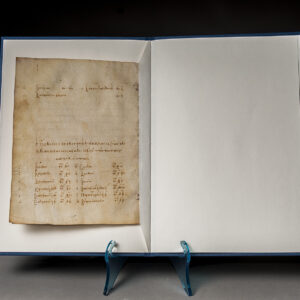
He Domenico Manni Collection Of Liturgical Manuscripts

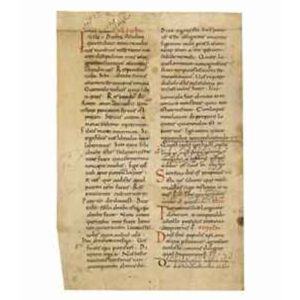
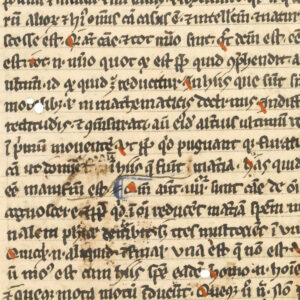
7 leaves and one part-leaf, 312 x 215mm — 372 x 265mm: (i) ORIGEN (d.253/4), translated by RUFINUS (d.410), In Numeros Homiliae, in Latin, [Italy, perhaps Tuscany, early 12th century], 2 almost complete leaves, two columns of 34 lines written in a fine rounded Carolingian minuscule bookhand in dark brown ink, the text containing parts of Homily XXVI and XXVII, with a December 1580 inscription in Italian on f.1v, 372 x 265mm; A MISSAL, in Latin, [Italy, probably Tuscany, early 13th century], 2 leaves, two columns of 31 lines written in brown ink, rubrics and initials in red, the text from the Sanctoral containing masses for Saints Zenobius, Romulus, Reparata and Cerbonius, all Tuscan, 311 x 215mm; ROLANDINUS RODOLPHINUS (d.1300), Summa artis notariae, in Latin, [Italy, late 13th or early 14th century], 1 leaf and one part leaf, two columns of 44 lines written in brown ink, rubrics and paraphs in red, the text containing parts of chapters VIII and IX, 320 x 223mm; A BREVIARY, in Latin, [Italy, late 14th century], two leaves, two columns of at least 23 lines, initials in red and blue, rubrics in red, with part of the text for Feria VI in Easter week, ownership inscriptions in Italian, 355 x 275mm (all recovered from bindings, some cropping, staining and creasing). All in modern card bindings.


Reference #

MS_BZ_1005

Civilization

Medieval , 1200 C.E. – 1400 C.E.

Size

7 leaves and one part-leaf, 312 x 215mm — 372 x 265mm

Condition

Fine Condition

Price

Price available upon request

Provenance

Baidun Collection, acquired at Christies sale November 2013

Leaf from an Illuminated Manuscript in Latin – Boethius, De Consolatione Philosophiae

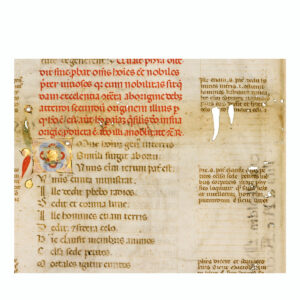
An Illuminated Manuscript On Vellum [Italy (Perhaps Florence), Fourteenth Century] a leaf, 315mm. by 230mm., 22 lines in a high grade angular bookhand, initials formed from ornamental penstrokes and separated from beginning of lines of verse, full border of the continuous gloss of the early fourteenth-century English author William Wheatley (see below) in smaller hand, rubrics and paragraph marks in red, two illuminated initials on blue or pink grounds with scrolling coloured acanthus leaves and large teardrop-like bezants, recovered from the binding of a series of Florentine historical works, partly by the Florentine humanist Matteo Palmieri, with sixteenth-century inscriptions identifying those works on its blank back, with scuffs, rubbing to initials, folds and small holes in places (with minor affect to 3 of glosses), overall in fair and presentable condition.

Reference #

MS_BZ_1010

Civilization

Byzantine, Medieval , 1400 C.E.

Size

H. 31.5 cm x W. 23 cm

Condition

Overall in fair and presentable condition

Price

Price available upon request

Provenance

Baidun Collection, acquired at Sotheby’s sale December 2013

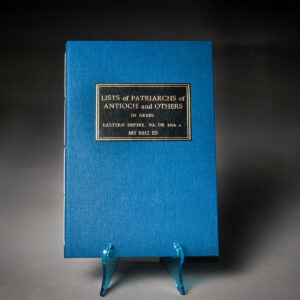
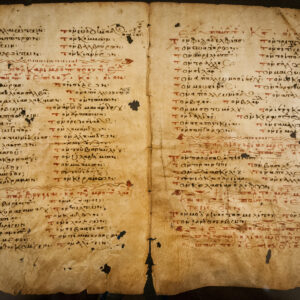
List of the Patriarchs of Antioch

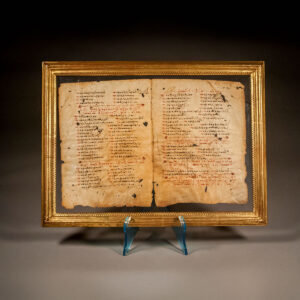
ANTIOCH preceded by the end of a list of the PATRIARCHS OF ALEXANDRIA and followed by a list of the canonical books of the Bible, in Greek, bifolium from a MANUSCRIPT ON VELLUM [Greece?, mid- to late- 10th century] 196 x 153mm. 17 lines ruled in blind written in brown ink in a fine and formal Greek minuscule, headings in uncials, modern foliation 46-47. In a modern cloth binding.

Provenance: (a) the conservative character of the writing is very marked, as is customary with the codices vetustissimi and vetusti of the 9th – 13th centuries. The minuscule slants slightly to the right, the breathings are square and the accents precise, and there is no enlargement of certain letters and intermixing with uncial forms as tends to happen in later centuries, all indicating a possible dating to the 10th century. The list of the Patriarchs of Alexandria ends with Peter IV (642-651), while the list of the Patriarchs of Antioch ends with Anastasius II (599-610), and the scribe has left space for 9 and 10 more names respectively, which would suggest he was copying the text from an earlier manuscript and writing a few centuries after the names listed. (b) ANDRe ROORYCK (1923-2010), sold at Sotheby’s, 5 July 2005, lot 7. An interesting and early bifolium from what would probably have been a compendium of useful religious dates, events, and lists relating to the Greek Orthodox Church. George I (621-630), Cyrus (631-641) and Peter IV (642-651) close the list of Patriarchs of Alexandria (following the Greek Orthodox as opposed to the Coptic Orthodox tradition, after the schism of 536), while the Patriarchs of Antioch run from Peter the Apostle (c.37 – 53) to Anastasius II (599-610).

Reference #

MS_BZ_1003

Civilization

Byzantine

Size

L. 19.6 cm, W. 15.3 cm

Condition

Fine Condition

Price

Price available upon request

Provenance

Baidun Collection

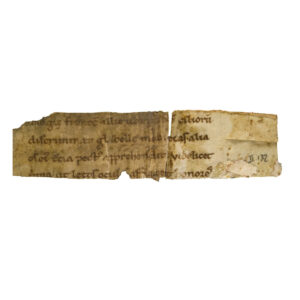
Martianus Capella, on the Marriage of Philology and Mercury in Latin

Manuscript Of The Text, In Latin, On Vellum [Germany, Early Twelfth Century] 9 fragments: 2 strips approximately 85mm. by 20mm. and 7 rectangular pieces, each approximately 42mm. by 25mm., one strip and one rectangle cut from same section of text allowing the reconstruction of 4 lines of a single column (35mm. wide): II:132-33, “Philologie frontem illuc ubi … oculis afflaret honores” and on back “sunt inclytam majestatem … hac regali lectica in”, and showing that the original volume was single-column and pocket-sized (with only approximately 21 lines missing between the lines here), other fragments with text from II:109, 110, 113, 130, and another part of 132, text in a fine late Carolingian hand with a pronounced ct-ligature, recovered from a binding of an sixteenth-century printed book from Leipzig, and hence with stains, cockling and splits.

Reference #

MS_BZ_1009

Civilization

Byzantine, Medieval , 1200 C.E.

Size

W. 8.5 cm, H. 2 cm

Condition

Fine condition

Price

Price available upon request

Provenance

Baidun Collection, acquired at Sotheby’s sale December 2013

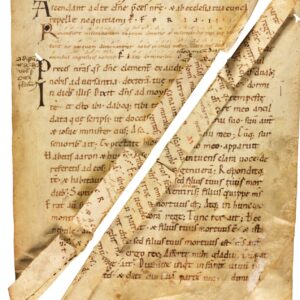
Nine Fragments From Early Liturgical Manuscripts

fragments: (i) 7 sections of leaves from a Missal, 5 triangular in shape (approximately 185mm. by 260mm.) and cut diagonally from the parent leaves, 2 further smaller pieces used as gathering supports (230mm. by 40mm. and 60mm. by 11mm.), the larger showing that the original codex was single column, 24 lines in light brown ink in a fine late Carolingian minuscule leaning to the right, with pronounced ct- and st-ligatures, lines of music in smaller script with simple neumes, rubrics (in ornamental capitals in style of ninth and tenth century) and simple red initials (some with tiny baubles at the head and foot), a few additions in later medieval hands including the apparent folio numbers “xxxi” and “xxxij” in late thirteenth-century script at the head of two leaves, Germany, second half of the eleventh century or c.1100; (ii) two long strips cut horizontally from a Lectionary leaf, each approximately 65mm. by 283mm., with remains of two columns of 7 lines of large and elegant early gothic script, rubrics and 17 one-line initials in red, Germany, mid-twelfth century; all recovered from bindings of early sixteenth-century books printed in Augsburg, and with some folds, scuffs, small stains and red ink oxidised to silver in places, but overall in good condition.

Reference #

MS_BZ_1012

Civilization

Byzantine, Medieval , 1100 C.E. – 1200 C.E.

Condition

Overall in good condition

Price

Price available upon request

Provenance

Baidun Collection, acquired at Sotheby’s sale December 2013


Partial List of Eparchies in the Byzantine Church with Bishoprics in Asia Minor

Greek bifolium from the inside of a gathering with Greek foliation in a later hand, ff. 119, 120. Written on vellum in a small, neat minuscule hand in dark brown ink with section heading, initials, and ornamental penwork divisions in red. It does not appear to have been ruled.
Date: 11th century. See V. Gardthausen, Griechische Palæographie: Zweiter Band: Die Schrift, Unterschriften und Chronologie im Altertum und im byzantinischen Mittelalter, Zweite Auglage (Leipzig: Verlag von Veit & Comp., 1913), Taf. 7.
Provenance: This was formerly in the collection of late Professor David Bitzer of the Union Theological Seminary in Richmond, Virginia, According to De Ricci & Wilson he obtained it from the London dealer Leighton. The consignor was a descendant of Bitzer.
Contents:
The contents follow that of the edition of the Notitiæ by Darrouzès. The list for each eparchy has been supplied from a scanned image of his work in Notitia 1, 144-326, pp. 207-211.

Reference #

MS_BZ_1014

Civilization

Byzantine

Baidun Collection,

acquired at Christies sale November 2013
Condition

Fine condition

Price

Price available upon request

Provenance

Baidun Collection

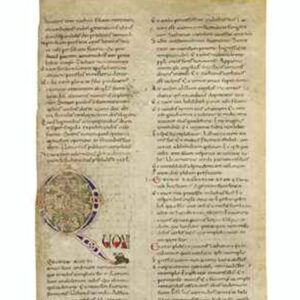
ROMANESQUE INITIAL ‘Q’ on a Leaf from a Monumental Bible

The initial in white, yellow, and blue, the shape of the ‘Q’ formed by an elaborate interlace pattern of white-vine scroll outlined in red, the infill with stylised foliage against a ground of green, 45 lines of text written in a handsome rounded protogothic transitional script in two columns, incipits in uncials touched red, initials in red (approximately 50 words, or 10 lines, trimmed from the bottom of each column, verso with adhesive stains to upper margin, not affecting the text). In a modern cloth binding. The recto opens with the end of thestandard Lucan prologue and continues with the beginning of Luke’s Gospel (Luke 1:1-25) — ‘Quoniam quidam multi conati sunt’; the verso continues with Luke 1:29-76. The layout of the text is unusual and interesting: verse 1 is here treated as the start of the book; often verses 1-4, the Dedication to Theophilus, are treated as a prologue, and verse 5 as the start of the Gospel proper. Both theMagnificat and the Benedictus, two of the six biblical canticles that were sung every week in all monasteries, are here written with enlarged red initials, their incipits in rustic capitals touched with red dots, and with left-justified red initials at the start of each phrase. The first lines of verses 18, 56, and 57 are treated similarly. The abstract, stylised design of the initial, with its intricate white-vine pattern and stark palette of primary colours testifies to the influence in Romanesque decoration of pre-Christian ornamental traditions. The fine example in the present leaf is closely reminiscent of an initial ‘A’ cut from another Romanesque bible, now at the Free Library in Philadelphia (Lewis E M 16:10)

Reference #

MS_BZ_1004

Civilization

Byzantine

Size

L. 38.2 cm , W. 27 cm

Condition

Fine Condition

Price

Price available upon request

Provenance

Baidun Collection

Unrecorded Carolingian Commentary on Psalms

CAROLINGIAN COMMENTARY ON THE PSALMS, in Latin, two bifolia from a MANUSCRIPT ON VELLUM [Italy, 9th century] 280 x 380mm. 4 leaves (2 bifolia), ruled in blind, preserving most of two columns per page, each with 27 lines written in Carolingian minuscule in brown ink, numerous initials in two sizes in red (recovered from a binding, and thus very worn on one side of each bifolium, and with significant losses on three sides). In an archival folder. Provenance: Sotheby’s, 19 June 1990, lot 1. Legible passages of text consist of short phrases of Psalm 67: verses 6, 9-14, 16-17, 19, 22, and 25, presented as short lemmata interspersed by passages of commentary. The eight pages appear to be textually consecutive and would therefore originally have been the central two bifolia of their gathering. THE COMMENTARY IS THUS FAR UNIDENTIFIED, AND PERHAPS NOT PREVIOUSLY RECORDED. In the 9th century there were three main commentaries on the Psalms: Augustine’s Ennarationes in Psalmos, Cassiodorus’s Expositio Psalmorum, and Pseudo-Jerome’s Breviarium; the present fragment is none of these. Other much rarer ones were the Glossa ex traditionum seniorum, Bede’s Titulatio, and the commentary found in the Mondsee Psalter. See M. Gibson, ‘Carolingian Glossed Psalters’, in R. Gameson, ed., The Early Medieval Bible: Its Production, Decoration and Use, Cambridge, 1994, esp. pp.96

Reference #

MS_BZ_1002

Civilization

Byzantine

Size

L. 28 cm, W. 38 cm

Condition

Fine Condition

Price

Price available upon request

Provenance

Baidun Collection, Christies sale November 2013
William Of Moerbeke’s Latin Translation Of Aristotle, Metaphysical

Three Leaves From A Decorated Manuscript On Vellum [Italy, Early Fourteenth Century]

3 leaves (a bifolium and a singleton), each 310mm. by 215mm., single column, 30 lines in black ink in a fine and professional university hand, capitals touched in red, paragraph marks alternately in red or blue, running titles in red “L[iber]” and “Phy[sica]” at head of each leaf, some early erasures and corrections, small flaws in vellum and occasional stains, else in fine condition.

Reference #

MS_BZ_1011

Civilization

Byzantine, Medieval, 1400 C.E.

Size

H. 31 cm x W. 21.5 cm

Condition

Some early erasures and corrections, small flaws in vellum and occasional stains, else in fine condition.

Price

Price available upon request

Provenance

Baidun Collection, acquired at Sotheby’s sale December 2013