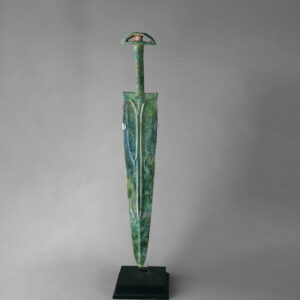
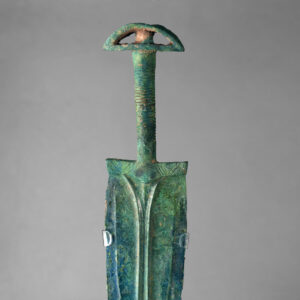
A Beautiful Wide Bronze Sword

This Persian sword is a remarkable example of the technology and design that went into crafting an ancient piece of weaponry. The dark hue of this sword lends it an austere weight, while the thick ribs and large crescent of the hilt are an indication of the strength required to wield such a heavy object. The broad blade seems to be made not for bludgeoning as much as cutting, with the raised ridge that runs along its length adding force to its blows.

This is a piece that makes a forceful statement in any collection, especially for collectors looking for a simpler alternative to the overwrought designs of later civilizations. The ancient Persians were known for their battle prowess, and this weapon is a fine example as to the tools ancient warriors had at their disposal. This sword has been wonderfully restored and displays a brilliant luster that still gleams along its long blade.


REFERENCE #

WP_PR_1111

CIVILIZATION

Persian, 1200 B.C.E. – 1100 B.C.E.

SIZE

L. 54 cm, 8 cm W

CONDITION

Excellent condition

PRICE

$11500

PROVENANCE

Jerusalem Private Collection
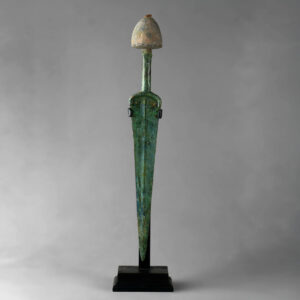
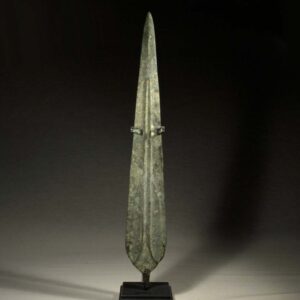
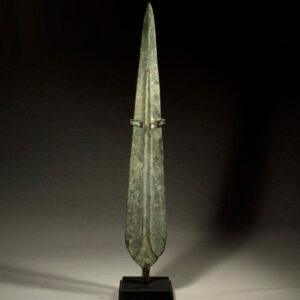
Ancient Bronze Thrusting Sword

This remarkable bronze weapon is a dagger or short sword from ancient Persia, specifically attributed to the Pre-Achaemenid Empire. During this period, the empire expanded extensively, establishing a formidable and centralized administrative structure that drove the production of luxurious and highly ornate high-status artifacts. Crafted by master smiths, this piece exemplifies the exceptional skill and artistry of Persian metallurgists, renowned for creating prestige items for the military forces.

The weapon features a distinctive strengthening spine, design element that facilitates both easier thrusting. The fine craftsmanship, intricate detailing, and functional design underscore its dual role as both a battlefield implement and a symbol of status and authority.


REFERENCE #

WP_PR_1114

CIVILIZATION

Persian, 1200-800 B.C.E.

SIZE

L. 41 cm

CONDITION

Fine condition

PRICE

$5000

Sale!

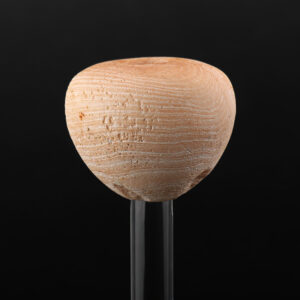
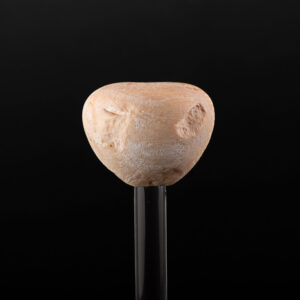
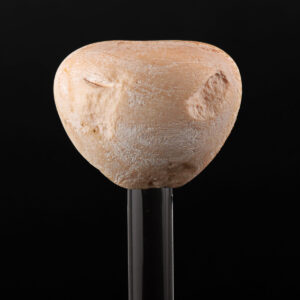
Banded Alabaster Egyptian Mace Head

Original price was: $2,000.00.Current price is: $1,850.00.

Description

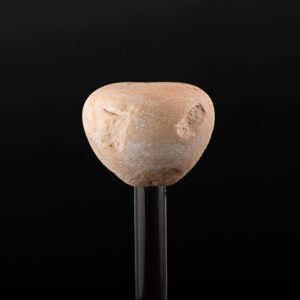
This commanding alabaster mace head exemplifies the artistry and technical skill of Egyptian stone‑workers of the Middle Bronze Age. Crafted from fine, dense alabaster, the piece presents a rounded, slightly pear‑shaped mass terminating in a short, tapering socket for hafting; its surfaces are smoothly finished to reveal the stone’s subtle veining and a soft, satin-like luster. Measuring approximately [dimensions available on request], it is a compact yet powerfully rendered implement.

The most striking feature of the mace head is its sculptural silhouette and the careful modulation of form between the striking face and the haft socket, which together create a balanced, purposeful object. The workmanship demonstrates mastery of stone‑shaping techniques, with precise contouring and evidence of controlled tool work around the socket and perimeter. Minor surface abrasions and faint impact marks may be present, consistent with functional use, while surviving tool marks are minimal and secondary to the overall polished presentation.

This object likely served both practical and symbolic roles: employed as a percussive weapon in conflict or as a status emblem and ceremonial object signaling authority and power. The selection of alabaster—a prized material—speaks to the prominence of its owner and the value attributed to finely

REFERENCE #

WP-PR-1002

CIVILIZATION

Egyptian, Circa 2100 B.C.E. – 1550 B.C.E.

Time Of Abraham

SIZE

L. 5cm

CONDITION

Fine condition

PRICE

$1850

PROVENANCE

The Baidun Collection

Banded Alabaster Egyptian Mace Head

This commanding alabaster mace head exemplifies the artistry and technical skill of Egyptian stone‑workers of the Middle Bronze Age. Crafted from fine, dense alabaster, the piece presents a rounded, slightly pear‑shaped mass terminating in a short, tapering socket for hafting; its surfaces are smoothly finished to reveal the stone’s subtle veining and a soft, satin-like luster. Measuring approximately [dimensions available on request], it is a compact yet powerfully rendered implement.

The most striking feature of the mace head is its sculptural silhouette and the careful modulation of form between the striking face and the haft socket, which together create a balanced, purposeful object. The workmanship demonstrates mastery of stone‑shaping techniques, with precise contouring and evidence of controlled tool work around the socket and perimeter. Minor surface abrasions and faint impact marks may be present, consistent with functional use, while surviving tool marks are minimal and secondary to the overall polished presentation.

This object likely served both practical and symbolic roles: employed as a percussive weapon in conflict or as a status emblem and ceremonial object signaling authority and power. The selection of alabaster—a prized material—speaks to the prominence of its owner and the value attributed to finely[/vc_column_text]

REFERENCE #

WP-PR-1002

CIVILIZATION

Egyptian, Circa 2100 B.C.E. – 1550 B.C.E.

Time Of Abraham

SIZE

L. 5cm

CONDITION

Fine condition

PRICE

$1850

PROVENANCE

The Baidun Collection

[/vc_column][/vc_row]

Sale!

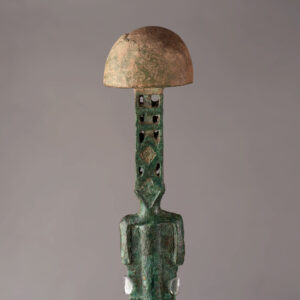
Bronze Double-Headed Bull Mace Head

Original price was: $30,000.00.Current price is: $25,000.00.

Description

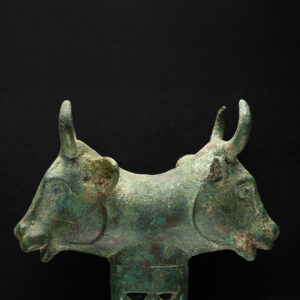
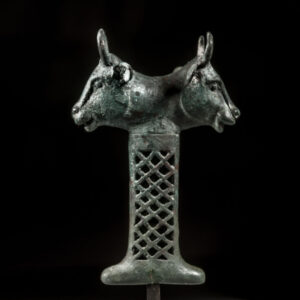
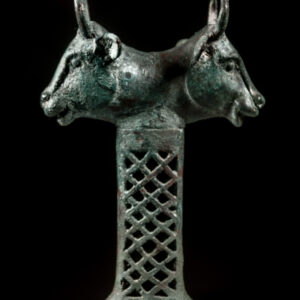
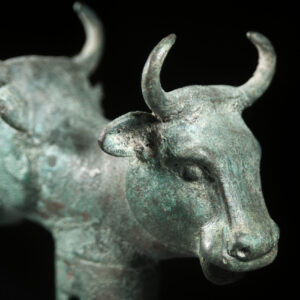
This Elamite Bronze Double-Headed Bull Mace Head, originating from the Near East region circa 2100–1550 B.C.E., is a striking example of ancient artistry and symbolism. The mace head features two imposing bull heads sculpted with remarkable detail and power, with their facial features exuding strength and dominance.

The bulls’ horns and expressions reflect the reverence for these animals in ancient cultures, often symbolizing fertility, power, and protection.

The handle, crafted in an openwork lattice style, showcases the artisan’s advanced skill in metalworking. The lattice pattern adds both aesthetic beauty and functional lightness to the piece. Though one of the bulls’ ears shows an ancient loss, the artifact remains in fine condition, its surface adorned with a rich natural patina, adding to its historical authenticity and appeal.

In the ancient Elamite kingdom, bulls were potent symbols of strength, fertility, and divine power, often associated with deities and rulers. This double-headed bull mace head likely held ceremonial or ritual significance, symbolizing authority, protection, or a connection to the divine. Its exquisite craftsmanship speaks to the advanced skills of the ancient Near Eastern metalworkers and their ability to imbue objects with profound cultural meaning.

REFERENCE #

WP_AT_1001

CIVILIZATION

Persian, Middle Bronze 2100 B.C.E. – 1550 B.C.E.

SIZE

L. 19 cm, W. 13 cm

CONDITION

Fine condition.

PRICE

$24850

Bronze Double-Headed Bull Mace Head

$25,000.00

This Elamite Bronze Double-Headed Bull Mace Head, originating from the Near East region circa 2100–1550 B.C.E., is a striking example of ancient artistry and symbolism. The mace head features two imposing bull heads sculpted with remarkable detail and power, with their facial features exuding strength and dominance.

The bulls’ horns and expressions reflect the reverence for these animals in ancient cultures, often symbolizing fertility, power, and protection.

The handle, crafted in an openwork lattice style, showcases the artisan’s advanced skill in metalworking. The lattice pattern adds both aesthetic beauty and functional lightness to the piece. Though one of the bulls’ ears shows an ancient loss, the artifact remains in fine condition, its surface adorned with a rich natural patina, adding to its historical authenticity and appeal.

In the ancient Elamite kingdom, bulls were potent symbols of strength, fertility, and divine power, often associated with deities and rulers. This double-headed bull mace head likely held ceremonial or ritual significance, symbolizing authority, protection, or a connection to the divine. Its exquisite craftsmanship speaks to the advanced skills of the ancient Near Eastern metalworkers and their ability to imbue objects with profound cultural meaning.[/vc_column_text]

REFERENCE #

WP_AT_1001

CIVILIZATION

Persian, Middle Bronze 2100 B.C.E. – 1550 B.C.E.

SIZE

L. 19 cm, W. 13 cm

CONDITION

Fine condition.

Bronze Persian Axe Head

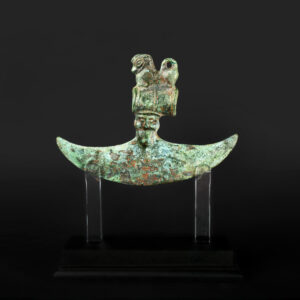
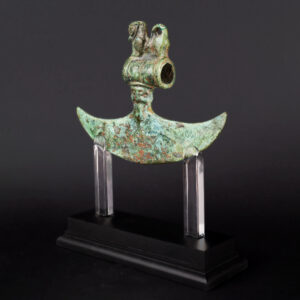
This remarkable ancient Elamite crescent axe features a distinctively curved, finely detailed blade that appears to emerge from the mouth of a bearded man, creating a powerful and evocative visual narrative. The figure of the bearded man, likely representing a deity or a legendary figure, is elegantly cast or carved, with a well-defined facial expression and beard, symbolizing strength or authority. The blade itself, attached seamlessly to the mouth, displays polished surfaces and sharp edges, indicative of high-quality craftsmanship from the Achaemenid periods. The axe’s shaft extends from the figure and is adorned with an intricate relief of a horse, symbolizing power, nobility, or martial prowess. The combination of the mythic figure, the dynamic crescent blade, and the equine motif reflects the sophisticated iconography and artistry characteristic of ancient Persia’s ceremonial weaponry. Crafted from bronze, this artifact exemplifies the masterful metallurgical techniques and symbolic artistry of the period.

REFERENCE #

WP_PR_1116

CIVILIZATION

Iron Age, 1200 B.C.E. – 900 B.C.E.

SIZE

L. 18 cm

CONDITION

Excellent condition, with dark green patina.

PRICE

$6998

PROVENANCE

The Private Collection of K. Baidun
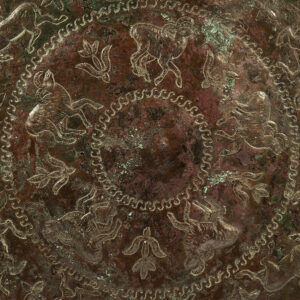
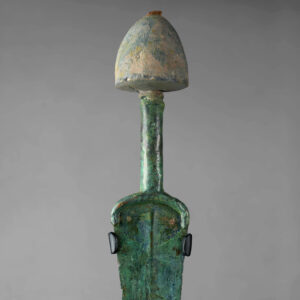
Bronze Thrusting Sword

RARE ANCIENT WESTERN ASIATIC SWORD WITH STONE POMMEL

IRON AGE,  ISRAELITE KINGDOM PERIOD

TIME OF KING DAVID

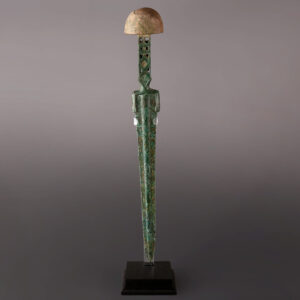
A Western Asiatic bronze Thrusting sword with a long, tapering blade, a prominent large polygonal mid-rib while gracefully curved. The hilt is characterized with a flat openwork cross-section and the dagger culminates in a distinctive, heavy pommel.

This sword was used for close range combat, to pierce armor.


REFERENCE #

WP-PR-1110

CIVLIZATION

NEAR EAST, PERSIA

CIRCA 1200-800 BC

SIZE

L. 50 cm

CONDITION

Fine Condition

PRICE

$9495

PROVENANCE

Private collection, 1980’s.

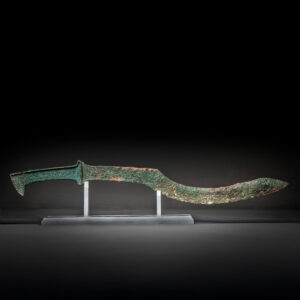
Canaanite Bronze Sickle Sword

Canaanite bronze sickle sword. The sword blade curves for two thirds of its length but is straight at its lower end. The handle has raised edges and ends in a “comma” to ensure the grip.

Reference: Y. Yadin, “The Art of Warfare in Biblical Lands” (London, 1963), p. 207

REFERENCE #

WP_MS_1001

CIVILIZATION

Canaanite, Late Bronze 1400 B.C.E.

SIZE

L. 56 cm

CONDITION

Fine condition

PRICE

Sold

Canaanite Large Decorated Spear Head

This magnificent leaf-shaped spear head was made by the Canaanites in the mid to late 2nd millennium B.C.E.. It displays excellent engineering and structural elements, particularly in terms of the bilateral central longitudinal fortified rib, widening to a broad tabular section at the butt end which was used to haft the spear head onto the shaft. The body tapers in both frontal and lateral profiles, making it a lethally effective weapon. The size also counts against anything other than a martial function, while the status associated with both warriors and large quantities of bronze (an expensive commodity at the time) marks it out as an important artifact.

Where found in context, such pieces are typically associated with prestige graves, and it would appear that they were probably as important in terms of appearance (i.e. conspicuous governance and threat) as in their evident lethality in combat. Indeed, at almost half a metre long, this piece would have been a very imposing item at the time of its manufacture, as indeed it is now. There is considerable evidence for diversity of manufacture across the Canaanite area, perhaps reflecting something of the modular yet martial nature of the time.

The Canaanites were one of the ‘tribal’ groups of what was to become Israel, Palestine and Jordan, who had their cultural roots in the Neolithic revolution when agriculture revolutionised Near East economics. By the Bronze Age the stability of the area and their position between great trading powers – notably Egypt and Mesopotamia – made them prosperous and culturally diverse, and was a high point for artistic creation. The culture contracted with economic issues suffered by Egypt and the Mesopotamians, and went through a collapse at the end of the Bronze Age due to a combination of ‘Sea People’ invasions, environmental meltdown and internal troubles in Egypt leading to loss of infrastructure throughout the Near East. Their resurgence of power in the Iron Age was matched by that of the Ammonites and Moabites, among others, and the region eventually came under control of the Neo-Assyrians by the mid 8th century B.C.E.. Such symbols of conspicuous consumption and authority are rare, especially in this excellent state of preservation and exquisite patination. This is an attractive and elegant piece of ancient art.

REFERENCE #

WP_PR_1043

CIVILIZATION

Canaanite, 1400 B.C.E. – 900 B.C.E.

SIZE

L. 47.5 cm

CONDITION

Fine condition

PRICE

Price available upon request

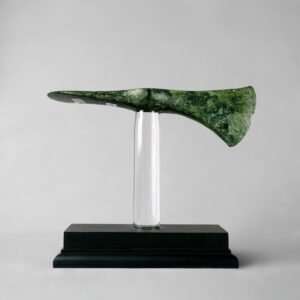
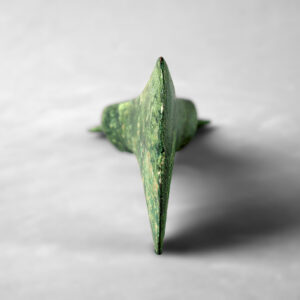
Israelite Kingdom Axe Head

A cast bronze axe head with a cylindrical socketing shaft, a tapered spike on the back end, and a horizontal axe blade on the front.

For similar see: Nikolaus Boroffka,  Simple technology. Casting moulds for axe-heads. In: Tobias L. Kienlin, Ben Roberts (ed.), Metals and society. Studies in honour of Barbara S. Ottaway.

Universitätsforschungen zur Prähistorischen Archäologie 169. Vertag

Dr. Rudolf Habelt GmbH (Bonn 2009), pp. 246-257, n. 1-2.


REFERENCE #

WP_PR_1115

CIVILIZATION

Canaanite, 1200 B.C.E. – 800 B.C.E.

Time of the Israelite Kingdom

SIZE

L. 20 cm

CONDITION

Fine condition

PRICE

$2500

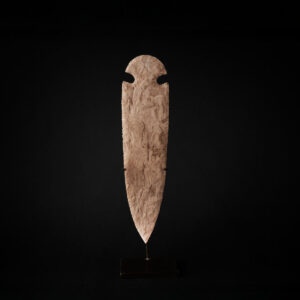
Neolithic Flint Dagger

This exceptional Neolithic flint dagger exemplifies the sophisticated stone tool craftsmanship of early Egypt or the broader Levantine region, dating from approximately 6000 to 3150 BCE. The elongated, pointed form showcases skillful knapping and pressure flaking techniques, with a smooth surface and subtle signs of use wear, indicating its original function as a utilitarian weapon or ceremonial object. Made from high-quality flint, its natural color ranges from light beige to pale brown, with a finely worked edge that demonstrates the precision and artistry of Neolithic artisans. This piece retains excellent preservation and exhibits the characteristic features of early prehistoric tools—both functional and symbolic. Its history and craftsmanship make it a noteworthy acquisition for collectors, museums, or institutions seeking authentic artifacts from one of the most significant periods in human history. An opportunity to acquire a unique and visually striking example of ancient stone technology with profound cultural and archaeological significance.

REFERENCE #

ST-CL-1003

CIVILIZATION

Egyptian, 4000 B.C.E.

SIZE

H 25 cm

CONDITION

fine condition.

PRICE

$8500