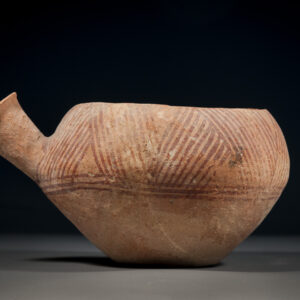
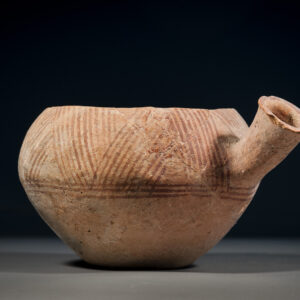
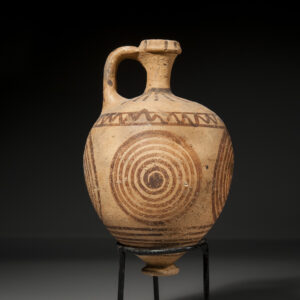
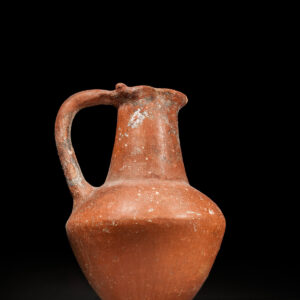
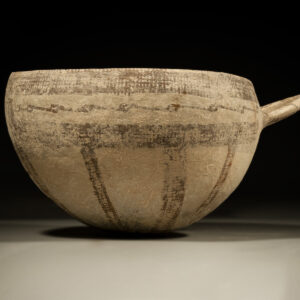
Wide Canaanite terra-cotta bowl with a single large spout protruding at a 45-degree angle from halfway up the body. The body tapers to a flattened base while the large mouth lacks embellishment. Monochrome paint marks the body’s upper half in parallel lines that intersect in diagonal planes.
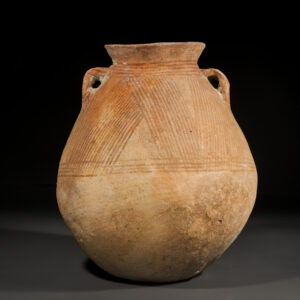
The thin lines that mark the top half of this large amphoriskos are on the primal end of art history, yet their application is so intricate as to reveal the care and attention to detail of the Canaanite artisan who applied them to the vessel’s exterior over 5000 years ago.
The large egg-shaped body of this amphoriskos allowed it to hold substantial amounts of liquid, be it wine, water or oil. The rich desert tones of its smooth exterior stand out boldly among the monochrome paint that scratch its surface.
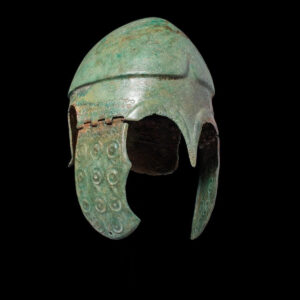
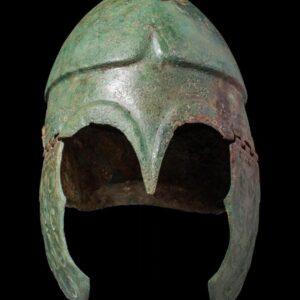
This helmet has a domed crown with medial ridge, with contoured inverted ‘V’ shape above the brow continuing as an occipital rib around the helmet, with pronounced arched brows and narrow flared neck guard, the hinges connected to intact original cheek-guards with rich green patina. The domed crown has a medial ridge, with a contoured inverted ‘V’ shape above the brow continuing as an occipital rib around the helmet, pronounced arched brows and a narrow flared neck guard; the hinges remaining connecting to cheek-pieces originally attached. ‘Chalcidian’ helmets are so named as they resemble those depicted on pottery from the Euboean city of Chalcis. They were used throughout the Greek world as a lighter, less bulky version of the earlier ‘Corinthian’ helmet.
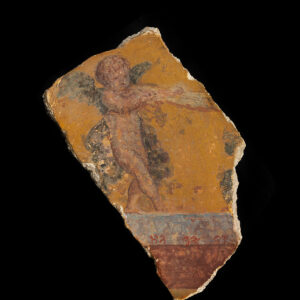
A fragment from a frieze depicting Eros as a winged child pulling on one end of a swag or garland. He is depicted naked apart from a cloak that hangs from his shoulders and behind his body, visible flapping loosely on either side of his legs. The fluttering ends of a cloak belonging to a second figure, presumably another Eros or possibly a Psyche, can be seen on the right. Painted on an ochre background with remains of two bands below of sky blue and terracotta. The edge of a lower register visible.
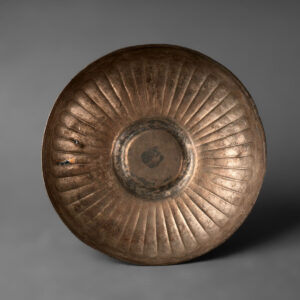
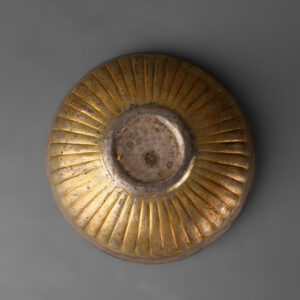
Gilded silver Phiale wine ribbed bowl from the Greco-Achaemenid period, circa 500–300 BC. This luxurious vessel measures approximately 18 cm in diameter and exemplifies the opulence of fine Greek and Persian craftsmanship during this era. The bowl features a shallow, broad form with a gently flared rim, designed both for aesthetic appeal and practical use.
The surface of the bowl is richly gilded, adding a radiant golden glow that accentuates its luxurious nature. Its most distinctive feature is the ribbed design, with evenly spaced, decorative flutes encircling the exterior that create a textured, elegant pattern and enhance its visual impact. The craftsmanship demonstrates a high level of skill, combining precise metalworking techniques with ornamental artistry.
Intended as a high-status drinking vessel for ceremonial or banquet use, this gilded silver Phiale reflects the cultural exchange and artistic refinement characteristic of the Greco-Achaemenid period. The combination of precious materials and intricate decoration signifies its importance as a symbol of wealth and prestige in social or religious contexts.REFERENCE #
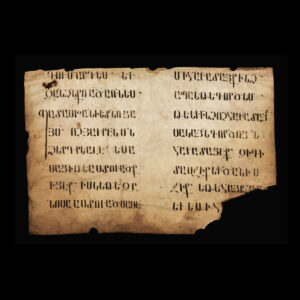
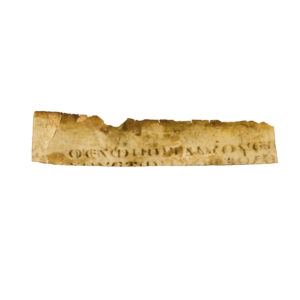
Four leaves from an extremely early Biblical codex. 4 leaves, with one complete leaf and a lower half (bisected horizontally across the page) from an early Armenian translation of John 10-11, the complete leaf 320mm. by 230mm., double column, 17 lines in dark brown ink in large and imposing erkat’agir majuscules (the so-called ‘Iron Writing’, the earliest Armenian script to survive in manuscript) with capitals with long trailing descenders, notably similar to British Library, Add. MS.21932, trimmed to edges of text, Armenia, probably ninth or tenth century; plus the lower half of a leaf from a Biblical or liturgical manuscript, 200mm. by 135mm., with remains of double column, 12 lines in light brown ink in a smaller and squarer hand closer to that of Dublin, Chester Beatty MSS.554 and 556, both twelfth century (Catalogue of the Armenian Manuscripts, 1958 II: pls.1 and 4), Armenia, probably twelfth century; all leaves recovered from bindings and with stains, tears, folds and later pen-trials and notes, but overall in fair and sound condition.
This is an extremely early and important witness to the Gospel of Mark, written within decades of the death of Jerome and Augustine of Hippo; it is perhaps from the Imperial library of Constantinople, the last of the great libraries of the ancient world This manuscript is from an important cache of early fragments, discovered in 2003, and reported to have been from a pre-War Armenian collection of antiquities and manuscripts in France. Five Biblical fragments, including the present one, were published by P.M. Head in the Journal of Theological Studies, ns.59 (2008), with short earlier notices in TC: A Journal of Biblical Textual Criticism, 8 (2003), Bulletin of the International Organization for Septuagint and Cognate Studies, 36 (2003) and the Tyndale Bulletin, 56 (2005). They include fragments of Luke (fifth century, and probably the oldest witness to that part of the text), John (late fifth century or even c.500), another fragment of Mark (fifth to sixth century) and Romans (sixth or seventh century). Subsequently, the other fragments have been identified as the oldest extant witness to the Lucianic recension of Jeremiah in Greek (early to mid-fifth century: Head ibid., pp.1-11), the only surviving witness to the Greek original text of the Testamentum Domini Nostri Jesu Christi (fifth century: Corcoran and Salway in Journal of Theological Studies, ns.62 (2011) pp.118-35), and the only surviving fragments of a series of imperial edicts made by third-century emperors and now named the Fragmenta Londiniensia Anteiustiniana (fifth century: Corcoran and Salway in Zeitschrift der Savigny Stiftung für Rechtsgeschichte: romanistische Abteilung, 127 (2010) pp.677-8, and Roman Legal Tradition, 6 (2010). Clearly these fragments of six early Bibles, a pseudo-Apostolic Church Order, and records of imperial edicts were once in a large and important library of the ancient world, in scope and chronological range far beyond that of a wealthy individual. There were large institutional libraries in Upper Egypt (such as that of the monastery founded by Pachomius c.320), Roman North Africa (as used by Augustine of Hippo in the late fourth and early fifth century), Milan (as used by Ambrose in the late fourth century) and Alexandria (as used by Bishop Gregory of Alexandria in the mid-fourth century), but the Eastern Empire was increasingly centred on Constantinople as its outlying territories fell prey to barbarian invasion. Jerome notes that the Lucianic recension of the Septuagint (including the fragment of Jeremiah noted above) was current only in Constantinople and Antioch in the early fifth century, and the collection of imperial edicts has been tentatively identified as also coming from the city. If so, it seems likely that they come from the Imperial Library in Constantinople, founded by Emperor Constantius II (reigned 337-61) as a scriptorium with the express purpose of copying fragile papyrus documents onto more stable vellum. Under Emperor Valens in 372 it employed four Greek and three Latin scribes. It survived a fire in 473, was sacked by the Normans in 1204 during the Fourth Crusade, and eventually destroyed only after the conquest of the city by the Ottoman Empire in 1453. The only other manuscript thought to be from this source is that of the Archimedes Palimpsest, which surfaced first in Constantinople in 1840 and is now in a private collection in America.
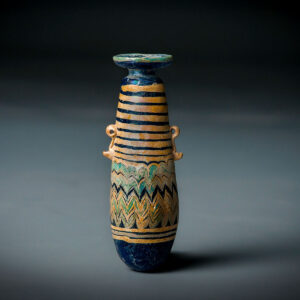
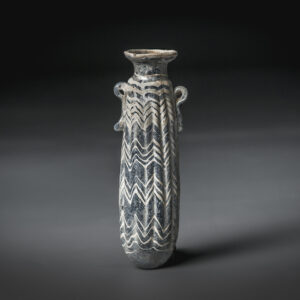
In translucent deep blue glass with opaque yellow and turquoise threads. The vessel has a wide everted rim edged in turquoise, a short neck and a long tubular body widening at the rounded base. A trail of yellow spirals around the upper half of the body in an anticlockwise direction. The lower half is decorated with rows of turquoise and yellow threads tooled into a zigzag pattern, three trails of yellow below. Two handles in yellow are applied towards the middle of the body.
Exhibited: San Diego Museum of Man, c. 1956
Literature: A less elegant example is illustrated in E. Marianne Stern, Birgit Schlick-Nolte, ‘Early Glass of the Ancient World, 1600 BC-AD 50. The Ernesto Wolf Collection’, (Germany, 1994) pp. 204-205.
REFERENCE #
GL_GR_1005
CIVILIZATION
Greco-Phoenician, 500 B.C.E. – 400 B.C.E.
SIZE
H. 12.4 cm
CONDITION
Intact
PRICE
Sold
PROVENANCE
Collection of the Dubois family, USA, acquired c.1920 and thence by descent.