Sale!

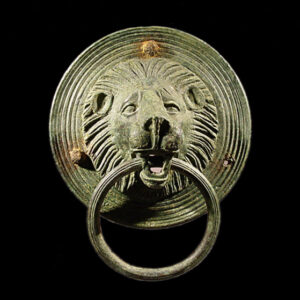
Bronze Handle in the Shape of a Lion’s Head

Original price was: $28,000.00.Current price is: $25,000.00.

Description

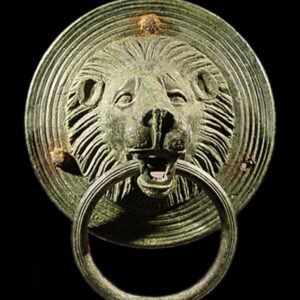
Here we see a bronze handle with a lion’s head holding the bronze ring from its mouth. This handle was cast sometime between 100 C.E. – 300 C.E. and depicts the lion in a highly realistic manner with much care given to the proportion of its protruding snout, fierce teeth, and vibrant mane. The heads of two iron nails remain from where the handle was hammered onto the surface from which it rested against. A series of concentric circles frame the lion’s head with beautiful precision, while the handle’s ring is fully intact and symmetrical.

This piece is in excellent condition and has a diameter of approximately 13 cm. The bronze has been cleaned and cared for, and all of its original details remain as fresh as the day they were cast. The lion has long been a symbol of strength and pride, and this piece continues to resonate across two thousand years of history.

REFERENCE #

SI_RM_1063

CIVILIZATION

Roman, 100 C.E. – 300 C.E.

SIZE

D. 13.7 cm

CONDITION

Fine condition

PRICE

$25,000

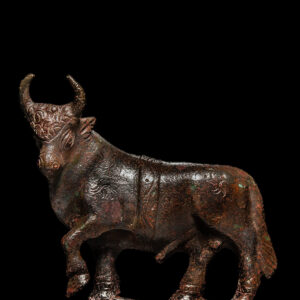
Bronze Imperial Roman Bull Stomping Hoof

Description

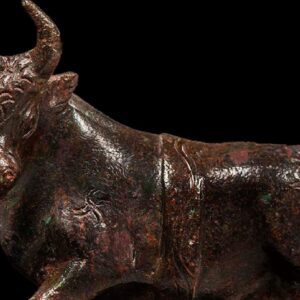
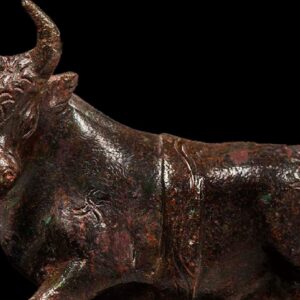
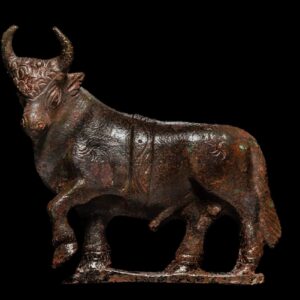
This incredible Bronze Imperial Roman Bull statuette dating from 200 – 300 C.E. is decorated with two stylized markings on its flanks and one large ribbon across its torso.  The bull’s powerful stance is accentuated by his head that is turned, as well as his front left leg that is raised in an aggressive stomping motion.  Additional decorations are present on the bull’s head in the form of decorous curls.  This Bronze Imperial Roman Bull statuette was part of a composed relief depicting a procession that leads to the sacrifice of the bull which was performed for the welfare of the Roman empire.

For more than 5,000 years, bronze and other copper alloys have been essential materials used to create everything from life-size sculptures to objects of daily life such as weapons, jewelry, tableware, and as featured here:  This incredible Bronze Imperial Roman Bull statuette.  Similar pieces are found in museums such as the Met Museum in New York City, but few found are as majestic and powerful as this piece.

Roman Bull in Cult of Magna Mater (Great Mother of the gods) Cybele

The religious practices of the Roman Empire of the 2nd to 4th centuries C.E. included the taurobolium, in which a bull was sacrificed for the well being of the people and the state. Around the mid-2nd century C.E. the practice became identified with the worship of Magna Mater (i.e. the Great Mother of the gods, Cybele), but was not previously associated only with that cult (cultus).

After 159 CE all private taurobolia inscriptions mention Magna Mater.  Public taurobolia enlisting the benevolence of Magna Mater on behalf of the emperor became common in Italy, Gaul, Hispania, and Africa. The last public taurobolium for which there is an inscription was carried out at Mactar in Numidia at the close of the 3rd century C.E. It was performed in honor of the emperors Diocletian and Maximian.


Roman Bull in Eastern Cult of Mithras

Another Roman mystery cult in which a sacrificial bull played a role was that of the 1st-4th century C.E. Mithraic Mysteries.  The cult of Mithras was very popular throughout the Roman Empire and was followed especially by soldiers.  It was one of several eastern cults that spread rapidly as a result of the Pax Romana (Roman peace) – others included the worship of Jupiter Dolichenus, Manichaeism, and of course Christianity.

Shrouded in secrecy, ancient mystery cults fascinate and capture the imagination.  Like all Greco-Roman mysteries, the cult of Mithraic Mysteries was limited to initiates, and there is very little known about the cult’s beliefs or practices.  In the so-called “tauroctony” artwork of that cult (cultus) – and which appears in all its temples – the god Mithras is seen to slay a sacrificial bull. The tauroctony should not be confused with a “taurobolium”, which was an actual bull-killing cult act performed by initiates of the Mysteries of Magna Mater, and has nothing to do with the Mithraic Mysteries.

Although there has been a great deal of speculation on the subject, the mystery that the tauroctony scene was intended to represent remains unknown.  Like the other ancient “mystery religions” such as the Eleusinian mysteries and the mysteries of Isis, Mithraism maintained strict secrecy about its teachings and practices, revealing them only to initiates. As a result, reconstructing the beliefs of the Mithraic devotees has posed an enormously intriguing challenge to scholarly ingenuity.

Owing to the Mithraic cult’s secrecy, we possess almost no literary evidence about the beliefs of Mithraism. The few texts that do refer to the cult come not from Mithraic devotees themselves, but rather from outsiders such as early Church fathers who mentioned Mithraism in order to attack it, as well as from Platonic philosophers who attempted to find support in Mithraic symbolism for their own philosophical ideas.

However, although our literary sources for Mithraism are extremely sparse, an abundance of material evidence for the cult exists in the many Mithraic temples and artifacts that archaeologists have found scattered throughout the Roman empire – from England in the north and west to Palestine in the south and east.  The temples – called mithraea by scholars – were usually built underground in imitation of caves.  These subterranean temples were filled with an extremely elaborate iconography: carved reliefs, statues, and paintings – depicting a variety of enigmatic figures and scenes. This iconography is our primary source of knowledge about Mithraic beliefs, but because we do not have any written accounts of its meaning the ideas that it expresses have proven extraordinarily difficult to decipher.


Sources:

1.) Met Museum – Bronze Statuette of Bull

2.) Met Museum – Bronze Plaque of Mithras slaying the bull

3.) Met Museum – Mystery Cults in the Greek and Roman World

4.) Harvard Art Museums – Ancient Mediterranean and Near Eastern Bronzes

5.) Wikipedia – Sacred Bull Roman Empire

6.) Wikipedia – Taurobolium

7.) Wikipedia – Magna Mater, Cybele

8.) Wikipedia – Tauroctony

9.) Wikipedia – Pax Romana

10.) Ulansey, D., “The Origin of Mithraic Mysteries”, 1991; and
  Ulansey, D., “Solving the Mithraic Mysteries” within:  Biblical Archaeology Review, vol. 20, #5 (September/October 1994) pp. 40-53

11.) The Tertullian Project – The Roman Cult of Mithras

 

REFERENCE #

SI_RM_1085

CIVILIZATION

Roman, 200 C.E. – 300 C.E.

SIZE

H. 16 cm

CONDITION

Fine condition

PRICE

Price available upon request

PROVENANCE

The Baidun Collection, Ex German Private Collection, acquired in the 1980’s

Bronze Persian Axe Head

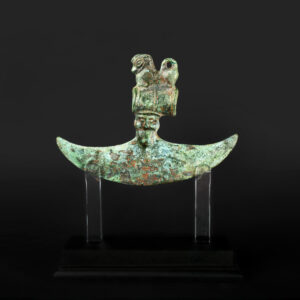
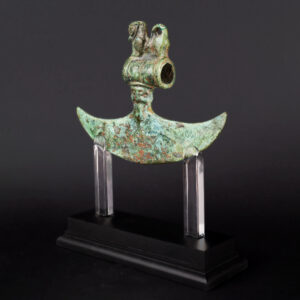
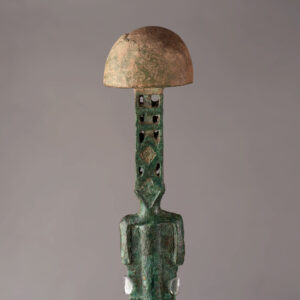
This remarkable ancient Elamite crescent axe features a distinctively curved, finely detailed blade that appears to emerge from the mouth of a bearded man, creating a powerful and evocative visual narrative. The figure of the bearded man, likely representing a deity or a legendary figure, is elegantly cast or carved, with a well-defined facial expression and beard, symbolizing strength or authority. The blade itself, attached seamlessly to the mouth, displays polished surfaces and sharp edges, indicative of high-quality craftsmanship from the Achaemenid periods. The axe’s shaft extends from the figure and is adorned with an intricate relief of a horse, symbolizing power, nobility, or martial prowess. The combination of the mythic figure, the dynamic crescent blade, and the equine motif reflects the sophisticated iconography and artistry characteristic of ancient Persia’s ceremonial weaponry. Crafted from bronze, this artifact exemplifies the masterful metallurgical techniques and symbolic artistry of the period.

REFERENCE #

WP_PR_1116

CIVILIZATION

Iron Age, 1200 B.C.E. – 900 B.C.E.

SIZE

L. 18 cm

CONDITION

Excellent condition, with dark green patina.

PRICE

$6998

PROVENANCE

The Private Collection of K. Baidun

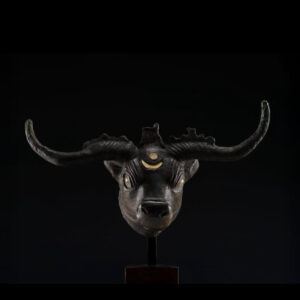
Bronze Sabaean Bull Head

Bronze bull head

A rare Sabaean bronze bull head.

Cast around a solid terracotta core the naturalistically modelled head has grooved eyebrows and neck, recessed nostrils, small erect ears and eyes with dark stone inlays, the pupils drilled. The forehead is also recessed with a small circle above a crescent, symbolic of the bull’s connection with the moon god. The long upward curving horn remains intact (left), restored (right) horn. A loop for suspension or attachment on top of the head. A very Strong and imposing piece.Powerful, enigmatic, and deeply expressive, this is a commanding piece that speaks to the strength and spiritual significance of the bull in Sabaean culture.

REFERENCE #
SI_SA_1018

CIVILIZATION SABAEAN,

CIRCA 200 B.C. – 100 B.C.

SIZE

H.16 cm

CONDITION

Fine condition

(Right Horn Restored)

PRICE
$45,000

PROVENANCE

Christies 23.3.71 Property of a Gentleman, from Al-Jubah to the south of Marib

Private collection UK, acquired late 1960s


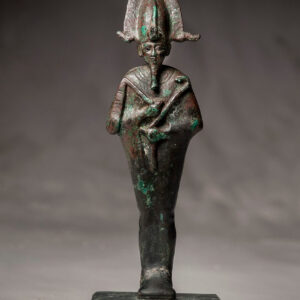
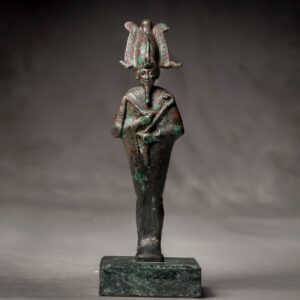
Bronze Statuette of Osiris

Bronze statuette of Osiris in traditional pose of arms crossed, holding a croREFERENCE #

SI_EG_1013

CIVILIZATION

Egypt, Late Period, 26th -30th Dynasty

SIZE

H. 22 cm

CONDITION

Fine condition

PRICE

$13,500

PROVENANCE

Private Jerusalem Collection, 1990s

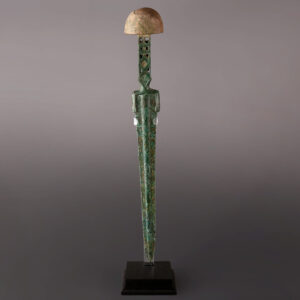
Bronze Thrusting Sword

RARE ANCIENT WESTERN ASIATIC SWORD WITH STONE POMMEL

IRON AGE,  ISRAELITE KINGDOM PERIOD

TIME OF KING DAVID

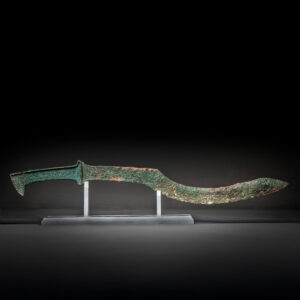
A Western Asiatic bronze Thrusting sword with a long, tapering blade, a prominent large polygonal mid-rib while gracefully curved. The hilt is characterized with a flat openwork cross-section and the dagger culminates in a distinctive, heavy pommel.

This sword was used for close range combat, to pierce armor.


REFERENCE #

WP-PR-1110

CIVLIZATION

NEAR EAST, PERSIA

CIRCA 1200-800 BC

SIZE

L. 50 cm

CONDITION

Fine Condition

PRICE

$9495

PROVENANCE

Private collection, 1980’s.

Bronze wine Philae bowl

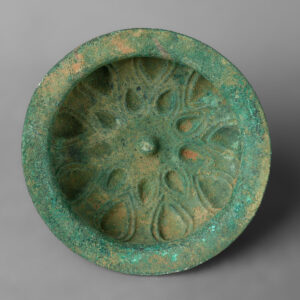
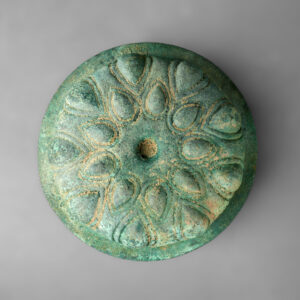
Bronze wine Phiale bowl from the Achaemenid period, circa 500 BC, dating to the time of Ezra and Nehemiah. This elegant vessel is crafted from bronze and measures approximately 16 cm in diameter. It features a shallow, broad form typical of Phiale bowls, with a gently flared rim that enhances its functional and decorative appeal.

The surface of the bowl is decorated with a detailed lotus motif, a symbol of purity, rebirth, and divine beauty, which was commonly used in Persian art and iconography. The intricate design is well-preserved and highlights the craftsmanship of Achaemenid metalworkers. The bowl is in perfect condition, with a rich blue patina that has developed over centuries, adding to its visual richness and historical authenticity.

The bronze material indicates that this vessel was a valued object, likely used in libations or ritual offerings during important ceremonies or banquets associated with the Persian court. Its decoration and form embody the aesthetic ideals and cultural values of the Achaemenid period, combining utility with artistic expression.

The craftsmanship and fine detailing of this bowl reflect a high level of technological skill, characteristic of the Achaemenid metallurgists. Such a substantial vessel was probably used in prestigious contexts, including royal banquets or religious rituals, serving both a utilitarian and decorative purpose.

REFERENCE #

B-22100

CIVILIZATION

Persian, Iron Age

CIRCA 800 B.C.E. – 500 B.C.E.

SIZE

DIAMETER. 16cm, HT. 7cm

CONDITION

Fine condition.

PRICE

$4000

Provenance

Jerusalem Private Collection

Canaanite Bronze Sickle Sword

Canaanite bronze sickle sword. The sword blade curves for two thirds of its length but is straight at its lower end. The handle has raised edges and ends in a “comma” to ensure the grip.

Reference: Y. Yadin, “The Art of Warfare in Biblical Lands” (London, 1963), p. 207

REFERENCE #

WP_MS_1001

CIVILIZATION

Canaanite, Late Bronze 1400 B.C.E.

SIZE

L. 56 cm

CONDITION

Fine condition

PRICE

Sold

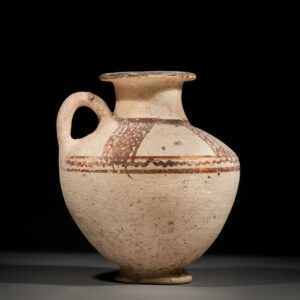
Canaanite Chocolate and White Ware Jug

Canaanite artisans were prolific, and their pottery came in an array of fantastic shapes, colors and sizes. This white ware jug is no exception, its ghostly exterior marked with dark brown lines that zigzag across the top half of its bulbous body. A wide base supports the body itself, while the short neck above ends at a large flat mouth.

A handle rises abruptly from the body and connects at the neck’s base, making a sturdy loop for the well-worn hands of an ancient Canaanite

REFERENCE #

KB_PT_1261

CIVILIZATION

Late Bronze Age IA, 1530 B.C.E. – 1480 B.C.E.

SIZE

H. 15.5

CONDITION

Fine condition

PRICE

Price available upon request

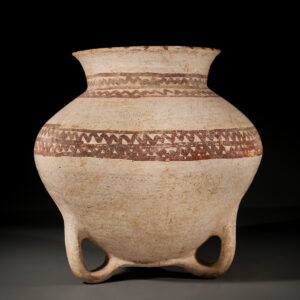
Canaanite Chocolate and White Ware Loop Footed Jar

The distinctive base of this Canaanite jar is made of three looped legs that prop the body up in tripod-like fashion. The design is more aesthetically pleasing than innovative, yet the rest of the jug was carefully made to exacting standards that allowed for the flawless curves of its white ceramic exterior.

The upper half of the jug is decorated with chocolate brown bands that alternate between straight lines and tightly wound zigzags. The overall effect is an ancient artifact imbued with a timeless sense of artistry and originality.REFERENCE #

KB_PT_1302

CIVILIZATION

Late Bronze Age IA, 1530 B.C.E. – 1480 B.C.E.

SIZE

H. 20 cm

CONDITION

Fine condition

PRICE

Price available upon request

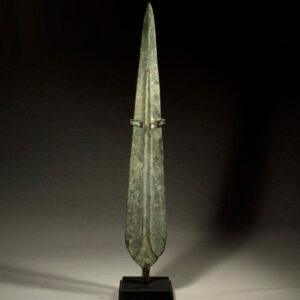
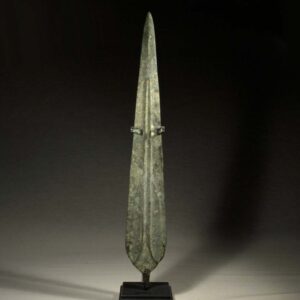
Canaanite Large Decorated Spear Head

This magnificent leaf-shaped spear head was made by the Canaanites in the mid to late 2nd millennium B.C.E.. It displays excellent engineering and structural elements, particularly in terms of the bilateral central longitudinal fortified rib, widening to a broad tabular section at the butt end which was used to haft the spear head onto the shaft. The body tapers in both frontal and lateral profiles, making it a lethally effective weapon. The size also counts against anything other than a martial function, while the status associated with both warriors and large quantities of bronze (an expensive commodity at the time) marks it out as an important artifact.

Where found in context, such pieces are typically associated with prestige graves, and it would appear that they were probably as important in terms of appearance (i.e. conspicuous governance and threat) as in their evident lethality in combat. Indeed, at almost half a metre long, this piece would have been a very imposing item at the time of its manufacture, as indeed it is now. There is considerable evidence for diversity of manufacture across the Canaanite area, perhaps reflecting something of the modular yet martial nature of the time.

The Canaanites were one of the ‘tribal’ groups of what was to become Israel, Palestine and Jordan, who had their cultural roots in the Neolithic revolution when agriculture revolutionised Near East economics. By the Bronze Age the stability of the area and their position between great trading powers – notably Egypt and Mesopotamia – made them prosperous and culturally diverse, and was a high point for artistic creation. The culture contracted with economic issues suffered by Egypt and the Mesopotamians, and went through a collapse at the end of the Bronze Age due to a combination of ‘Sea People’ invasions, environmental meltdown and internal troubles in Egypt leading to loss of infrastructure throughout the Near East. Their resurgence of power in the Iron Age was matched by that of the Ammonites and Moabites, among others, and the region eventually came under control of the Neo-Assyrians by the mid 8th century B.C.E.. Such symbols of conspicuous consumption and authority are rare, especially in this excellent state of preservation and exquisite patination. This is an attractive and elegant piece of ancient art.

REFERENCE #

WP_PR_1043

CIVILIZATION

Canaanite, 1400 B.C.E. – 900 B.C.E.

SIZE

L. 47.5 cm

CONDITION

Fine condition

PRICE

Price available upon request

Canaanite Loop Footed Painted Jar

A Canaanite loop footed painted jar


REFERENCE #

KB_PT_0060

CIVILIZATION

Middle Bronze Age, 1700 B.C.E. – 1600 B.C.E.

SIZE

H. 26.5 cm

CONDITION

Fine condition

PRICE

Price available upon request

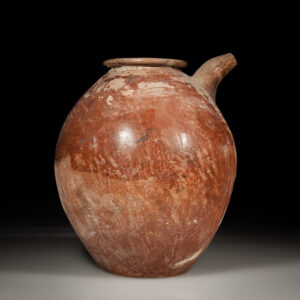
Canaanite Red Slip Spouted Jar

The natural polish of this red slip spouted jar shines brightly even under the softest of lights. The large ovoid body of this piece has no neck, but instead a flattened ring atop its mouth and a bent spout with a small hole for measured pouring. This suggests an efficiency commonly found throughout the arid regions of ancient Canaan, when water and wine were too important for the casual spill.


REFERENCE #

KB_PT_0597

CIVILIZATION

Early Bronze Age, 3500 B.C.E. – 3000 B.C.E.

SIZE

H. 23 cm

CONDITION

Fine condition

PRICE

Price available upon request

Ceramic Canaanite Spouted Bowl

Wide Canaanite terra-cotta bowl with a single large spout protruding at a 45-degree angle from halfway up the body. The body tapers to a flattened base while the large mouth lacks embellishment. Monochrome paint marks the body’s upper half in parallel lines that intersect in diagonal planes.

REFERENCE #

KB_PT_2901

CIVILIZATION

Early Bronze Age, 3500 B.C.E. – 3000 B.C.E.

SIZE

L. 18 cm

CONDITION

Repaired

PRICE

Price available upon request