Showing 145–160 of 174 results
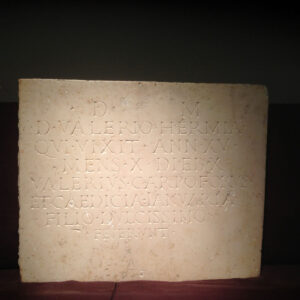
Roman Inscription Under the Name of VALERIO HERMIA
Reference #
SC_RM_1001
Civilization
Roman, 100 C.E. – 200 C.E.
Size
L. 45 cm, H. 40 cm
Condition
Fine Condition
Price
SOLD
Provenance
Baidun Collection
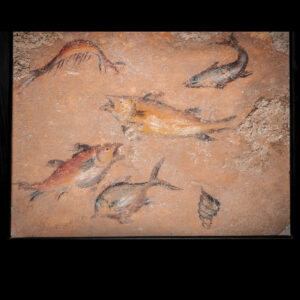
Roman Pompeian Wall Fresco with Aquarium-like Swimming Fish
The origins of fresco painting are unknown, but it was used as early as the Minoan civilization (at Knossos on Crete) and by the ancient Romans (at Pompeii). The Italian Renaissance was the great period of fresco painting, as seen in the works of Cimabue, Giotto, Masaccio, Fra Angelico, Correggio and many other painters from the late 13th to the mid-16th century.
Fresco is a technique of mural painting executed upon freshly-laid lime plaster. Water is used as the vehicle (or medium) for the pigment, and with the setting of the plaster the painting becomes an integral part of the wall.
Roman Pompeian Wall Fresco – 3rd Style (Period)
This extremely fine fresco is an exquisite example of ancient Roman art, originates from Pompeii in ancient Rome, and is of the 3rd Pompeian Style that was popular 20-10 BCE. This 3rd Pompeian Style (and Period) emerged and developed as a reaction to the austerity of the previous period. It leaves room for more figurative and colorful decoration, with an overall more ornamental feeling, and often presents great finesse in execution. This style is typically noted as simplistically elegant.
One who beholds this fresco today wonders if the ancient Romans were making a first proto-attempt to illustrate the conceived notion of an aquarium before the advent of modern glass and other technologies that would make the invention of aquariums actually possible in the 19th century CE. It seems that the artist who painted this fresco was attempting to create a calm and relaxing environment for those who sat in the room whose walls were decorated with this fresco of swimming fish in an Aquarium-like motif – which was extremely innovative and insightful to have the foresight in his/her day 19 centuries before the advent and invention of glass aquariums!
Pompeii Destroyed by Volcanic Eruption of Vesuvius
On 24 August 79 CE, the city of Pompeii was destroyed by the violent eruption of the volcano Vesuvius. The eruption destroyed the city, killing its inhabitants and burying it under tons of ash. The circumstances of their destruction preserved their remains as a unique document of Greco-Roman life. Pompeii supported between 10,000 and 20,000 inhabitants at the time of its destruction. Fortunately for this Fresco, it also has survived and has remained intact in Fine Condition. Provenance is excellent: acquired in the 1980s, Ex. Private Swiss Collection.
The ruins at Pompeii were first discovered late in the 16th century CE by the architect Domenico Fontana. Herculaneum was discovered in 1709 CE, and systematic excavation began there in 1738 CE. Work did not begin at Pompeii until 1748 CE, and in 1763 CE an inscription (“Rei publicae Pompeianorum”) was found that identified the site as Pompeii. The work at these towns in the mid-18th century marked the start of the modern science of archaeology.
Mount Vesuvius erupted 24 August 79 CE. A vivid eyewitness report is preserved in two letters written by Pliny the Younger to the historian Tacitus, who had inquired about the death of Pliny the Elder, commander of the Roman fleet at Misenum. Site excavations and volcanological studies, notably in the late 20th century CE.
Just after midday on 24 August, fragments of ash, pumice, and other volcanic debris began pouring down on Pompeii, quickly covering the city to a depth of more than 9 feet (3 metres) and causing the roofs of many houses to fall in. Surges of pyroclastic material and heated gas, known as nuées ardentes, reached the city walls on the morning of 25 August and soon asphyxiated those residents who had not been killed by falling debris. Additional pyroclastic flows and rains of ash followed, adding at least another 9 feet of debris and preserving in a pall of ash the bodies of the inhabitants who perished while taking shelter in their houses or trying to escape toward the coast or by the roads leading to Stabiae or Nuceria.
Thus Pompeii remained buried under a layer of pumice stones and ash 19 to 23 feet (6 to 7 metres) deep. The city’s sudden burial served to protect it for the next 17 centuries from vandalism, looting, and the destructive effects of climate and weather.
REFERENCE #
SW_MS_1103
CIVILIZATION
Roman, Pompeii 3rd Period, 100
SIZE
31 cm x H. 36.5 cm
CONDITION
Fine condition
PRICE
Price available upon request
PROVENANCE
Ex. Private Swiss collection, Acquired 1980s

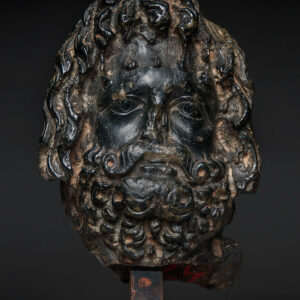
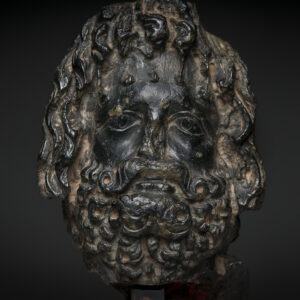
Roman-Egyptian Schist Stone Head Bust of Greco-Egyptian god Zeus Serapis
This Roman-Egyptian head bust of the Greco-Egyptian god Zeus Serapis is finely sculpted from black schist stone, and dates from the Roman-Egyptian Period, 100 C.E. – 200 C.E. Representations of Serapis are uncommon. The most famous representation of the deity is that by Bryaxis, the famous sculptor who is credited with creating the sculptures on the north side of the tomb of Maussollos – one of the wonders of the ancient world. Other works of Bryaxis include a bronze statue of Seleucus, king of Syria, five huge statues at Rhodes, and a statue of Apollo at Daphne near Antioch.
The depiction of Serapis is uncommon, and this sculptor’s attention to detail is evident in all aspects of the piece: Wavy hair locks flow elegantly down the back and sides of Serapis’ head, as hair bangs drape across his forehead. His thick, full beard of curly hair locks covers his face in the classic style of ancient Greece which regarded the beard as a badge or sign of virility; Greek beards were also frequently curled with tongs.
Even though from the earliest times in ancient Greece the shaving of the upper lip was not uncommon, here Serapis is depicted with full handlebar mustache which curls upward on both sides of his face, revealing only his bottom lip. The superb craftsmanship of this piece is manifest down to the finest details in Serapis’ eyes which reveal the corneas that are clearly distinguishable from the sclera of each eye, and each is accentuated by delicate, finely-crafted eyelids as well as with expressive, arched eyebrows which are visible under the hair bangs.
Some of these hair locks that cover the forehead are missing, as well as part of the nose which were broken in antiquity. The cult of Serapis was banned in 391 C.E. and many of the sculptures destroyed. Therefore this fine specimen is an uncommon example that has survived the ravages of history, and thus is a very notable piece of rare ancient art.
The Cult of Serapis / Sarapis
The cult of Serapis was introduced during the 3rd century B.C.E. on the orders of Ptolemy I of Egypt as a means to unify the Greeks and Egyptians in his realm. Sarapis was a syncretistic deity derived from the worship of the Egyptian Osiris and Apis (Osiris + Apis = Oserapis/Sarapis).
Serapis also gained attributes from other deities, such as chthonic powers linked to the Greek Hades and Demeter, as well as benevolence linked to Dionysus. However, although he was identified with various Greek gods, Serapis was above all – because of his authority and his association with rulers (the Ptolemies in this case) – identified with Zeus.
Ptolemy I Soter (r. 305–284 B.C.E) commissioned the syncretistic god Serapis in order that the native population of Egypt – who already had an extensive pantheon of deities – and the occupying forces of Greece could have a common ritual focus, and he centered the worship of the deity at Alexandria. Serapis (or Sarapis) was a Greco-Egyptian deity of the Sun first encountered at Memphis where his cult was celebrated in association with that of the sacred Egyptian bull Apis (who was called Osorapis when deceased). The god therefore shared a group of attributes common to Greeks (physically robust, bearded male) and to Egyptians (attire and accessories). He was originally shown seated, with a sceptre of power, wearing a grain measure on his head, accompanied by a snake (identified with the Egyptian royal uraeus) and with a dog (originally held to be Anubis, later Cerberus) by his side.
Sources:
1.) Art Fund – Bust of Zeus Serapis by Greek
2.) Met Museum – Gold statuette of Zeus Serapis
3.) Britannica – Serapis
4.) Britannica – Apis
5.) Britannica – Ptolemy I Soter
6.) Wikipedia – Serapis or Sarapis
7.) Wikipedia – Beards in Ancient Greece
8.) Wikipedia – Bryaxis
9.) University of Chicago – The Temple of Serapis at Alexandria
10.) Book – “Zeus” by Ken Dowden[/vc_column_text]
REFERENCE #
SI_RM_1099
CIVILIZATION
Roman-Egyptian Period, 100 C.E. – 200 C.E.
SIZE
H. 11.4 cm
CONDITION
Fine condition, some of the hair locks from the forehead are missing.
PRICE
$23,000
PROVENANCE
Ex French private collection, acquired 1975.
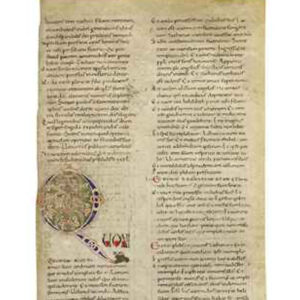
ROMANESQUE INITIAL ‘Q’ on a Leaf from a Monumental Bible
The initial in white, yellow, and blue, the shape of the ‘Q’ formed by an elaborate interlace pattern of white-vine scroll outlined in red, the infill with stylised foliage against a ground of green, 45 lines of text written in a handsome rounded protogothic transitional script in two columns, incipits in uncials touched red, initials in red (approximately 50 words, or 10 lines, trimmed from the bottom of each column, verso with adhesive stains to upper margin, not affecting the text). In a modern cloth binding. The recto opens with the end of thestandard Lucan prologue and continues with the beginning of Luke’s Gospel (Luke 1:1-25) — ‘Quoniam quidam multi conati sunt’; the verso continues with Luke 1:29-76. The layout of the text is unusual and interesting: verse 1 is here treated as the start of the book; often verses 1-4, the Dedication to Theophilus, are treated as a prologue, and verse 5 as the start of the Gospel proper. Both theMagnificat and the Benedictus, two of the six biblical canticles that were sung every week in all monasteries, are here written with enlarged red initials, their incipits in rustic capitals touched with red dots, and with left-justified red initials at the start of each phrase. The first lines of verses 18, 56, and 57 are treated similarly. The abstract, stylised design of the initial, with its intricate white-vine pattern and stark palette of primary colours testifies to the influence in Romanesque decoration of pre-Christian ornamental traditions. The fine example in the present leaf is closely reminiscent of an initial ‘A’ cut from another Romanesque bible, now at the Free Library in Philadelphia (Lewis E M 16:10)
Reference #
MS_BZ_1004
Civilization
Byzantine
Size
L. 38.2 cm , W. 27 cm
Condition
Fine Condition
Price
Price available upon request
Provenance
Baidun Collection
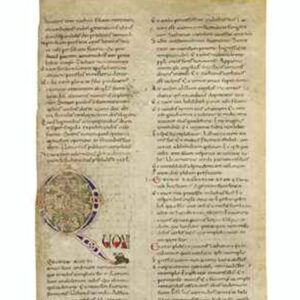
ROMANESQUE INITIAL ‘Q’ on a Leaf from a Monumental Bible
The initial in white, yellow, and blue, the shape of the ‘Q’ formed by an elaborate interlace pattern of white-vine scroll outlined in red, the infill with stylised foliage against a ground of green, 45 lines of text written in a handsome rounded protogothic transitional script in two columns, incipits in uncials touched red, initials in red (approximately 50 words, or 10 lines, trimmed from the bottom of each column, verso with adhesive stains to upper margin, not affecting the text). In a modern cloth binding. The recto opens with the end of thestandard Lucan prologue and continues with the beginning of Luke’s Gospel (Luke 1:1-25) — ‘Quoniam quidam multi conati sunt’; the verso continues with Luke 1:29-76. The layout of the text is unusual and interesting: verse 1 is here treated as the start of the book; often verses 1-4, the Dedication to Theophilus, are treated as a prologue, and verse 5 as the start of the Gospel proper. Both theMagnificat and the Benedictus, two of the six biblical canticles that were sung every week in all monasteries, are here written with enlarged red initials, their incipits in rustic capitals touched with red dots, and with left-justified red initials at the start of each phrase. The first lines of verses 18, 56, and 57 are treated similarly. The abstract, stylised design of the initial, with its intricate white-vine pattern and stark palette of primary colours testifies to the influence in Romanesque decoration of pre-Christian ornamental traditions. The fine example in the present leaf is closely reminiscent of an initial ‘A’ cut from another Romanesque bible, now at the Free Library in Philadelphia (Lewis E M 16:10)
Reference #
MS_BZ_1004
Civilization
Byzantine
Size
L. 38.2 cm , W. 27 cm
Condition
Fine Condition
Price
Price available upon request
Provenance
Baidun Collection
Schist Achamaenid Wing With Phoenix
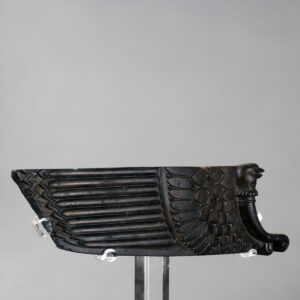
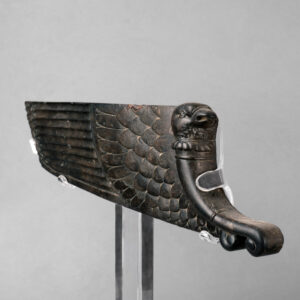
This schist wing, dating from the Achaemenid period circa 500–300 BC and measuring approximately 27.5 centimeters, exemplifies the sophisticated craftsmanship and symbolic motifs of the era. The carved stone fragment depicts a stylized wing, notable for its intricate workmanship and symbolic significance. Central to the design is a finely incised and carefully modeled relief of a phoenix, a mythological bird emblematic of renewal, immortality, and divine protection—an iconic motif in Persian art. The detailed depiction demonstrates the skillful use of incisions and relief carving, highlighting the artisans’ mastery of stonework.
Originally, this fragment would have been part of an elaborate furniture decoration, potentially serving as a decorative panel or ornament within a throne, throne room, or ceremonial setting. The use of schist, a durable and locally sourced stone, reflects both aesthetic preferences and the technical capabilities of Achaemenid artisans. The phoenix motif underscores themes of rebirth and divine authority, aligning with the rich iconography prevalent in Persian cultural and religious symbolism.
Today, this fragment preserves the fine craftsmanship and sophisticated iconography characteristic of Achaemenid decorative arts. Its preserved details provide valuable insights into the visual language and ceremonial ornamentation of the Persian elite, illustrating the grandeur and symbolic complexity that adorned the architecture and surroundings of the ruling class in the ancient empire. REFERENCE #
SI_PR_1019
CIVILIZATION
Persian, 500 B.C.E.
SIZE
H. 27.5cm
CONDITION
Fine Condition
PRICE
$27500
PROVENANCE
Jerusalem Private Collection, late 1970’s.
Silver Coin of Alexander The Great
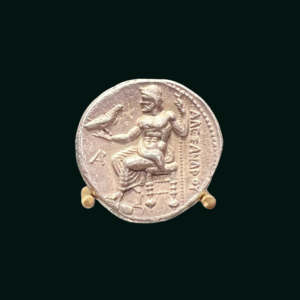
Silver Tetradrachm coin of Alexander the Great[/vc_column_text]
REFERENCE #
CO_GR_1003
CIVILIZATION
GREEK, 333 B.C.E.
SIZE
D. 3cm
CONDITION
Excellent Condition
PRICE
$1500
Silver Pair of Sphinx Handles
Two handles from a bowl, pot or goblet. The square section is hollow and convex in shape to make holding the vessel easier. Each handle terminates in a sphinx standing on its back legs, with its front paws outstretched. These would be the point where the handles were attached to the upper area of the vessel.
The sphinxes are identical apart from the fact that one head looks to the left and the other to the right, although not quite to the same degree. They are depicted according to the Greek social conception of this mythological creature. Each has the bust of a woman, the body and tail of a lion, great bird wings and a female human head. Each head is depicted wearing a diadem and with the hair swept up and held at the back of the head in a bun. The precision and detail of the working of the faces and wings is notable, giving a sense of movement and realism to the pair. One can appreciate a clear attempt to differentiate between the feathers of the wings: those inserted into the body itself are small and short, rather like scales, while those at the extreme end of the wings are long and narrow, to help the creature take flight.
According to ancient literary sources, the sphinx was a monster with the face and bust of a woman, the claws of a lion, the body of a dog, the tail of a snake and wings of a bird. This demon of divine origin, whose presence excited uncertainty and terror in humans, was also characterized by its pallid appearance, fiery look and venomous mouth. It’s possible that this hybrid had its origin in Egyptian iconography, where it was represented with a feline body and human face, possibly connected to the divine power of the pharaoh.
The sculptural prototype of Greek sphinxes appears around the 7th century BCE in terracotta and was usually found decorating large receptacles. A century later they appeared in marble crowning seated ex-votos on a column. The monstrous, aggressive nature of the hybrid was channelled into funerary art, serving as an apotropaic symbol to keep away malevolent forces. It was usual, therefore, to find this iconography in metopes and hollow acroteria in Greek necropoleis of the 6th century BCE, usually with the animal in profile and turning its head toward the public in an attitude of defiance.
Reference #
SI_GR_1034
Civilization Greek,
5th – 4th century B.C.E.
Size
H. 14 cm
Condition
Intact, Fine
Price
P.O.R.
Provenance
Private collection, Great Britain. Acquired before 1975