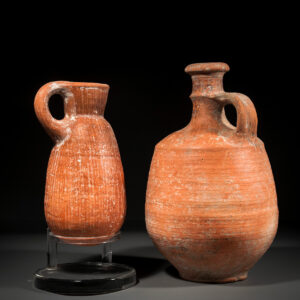
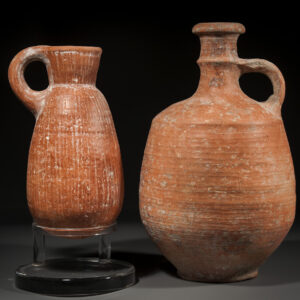
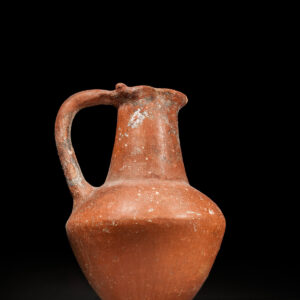
These ancient Israeli red slip ceramic vessels were found together in the mountains west of the Jordan River, an area known both then and now as Samaria. The smaller vessel with the large mouth is a wine decanter while the larger jug was made to hold large amount of cooking oil for generous use in old Israeli cuisine.
There is something homey, even quirky, about the thick handles that loop at the top of each vessel. The warm red colors of their grooved exterior transports us to a dimly lit kitchen filled with the smells of traditional meals still savored today across the Levant.
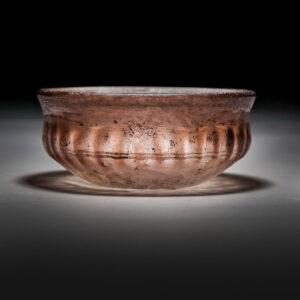
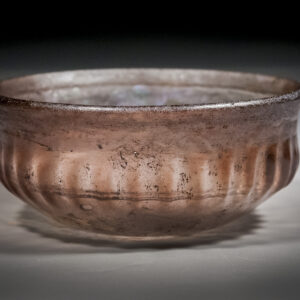
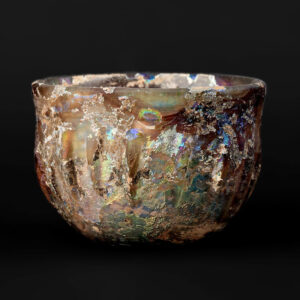
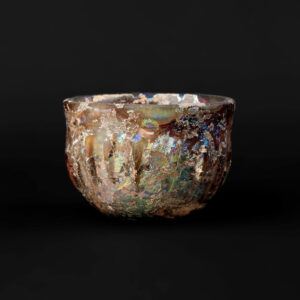
This elegant ribbed glass bowl exemplifies the artistry and technical skill of early Roman glassmakers. Crafted from a rare aubergine-hued soda‑lime glass, the bowl presents a gently flared rim and a rounded, harmonious profile with a lustrous, weathered surface that reveals a rich, multicolored iridescence developed through centuries of natural burial conditions. Measuring approximately [dimensions available on request], it is a compact yet striking domestic vessel.
The most striking feature of the bowl is its pronounced vertical ribbing, which encircles the body and lends a rhythmic, tactile quality to the form. Two finely incised concentric lines around the midsection provide an elegant counterpoint to the ribs, demonstrating careful finishing by hand. The surface iridescence, a product of long-term chemical interaction rather than modern treatment, enhances the deep aubergine tone and accentuates the delicate interplay of light across the exterior.
The workmanship shows mastery of early glass techniques—likely mold‑forming for the ribbed body with subsequent hand incision—resulting in crisp, well-executed details and a smoothly rendered rim. The uncommon deep purple color and strong iridescent sheen mark this piece as a particularly refined example of provincial Roman glass production.
Likely used for both every day and display purposes, this bowl would have served as a functional domestic vessel and possibly as a valued item within a household’s tableware. Its durable glass, sophisticated surface effects, and rare coloration reflect both the aesthetic sensibilities and material culture of the early Imperial period. Found in Sabaste; early Roman, ca. 1st century AD.REFERENCE #
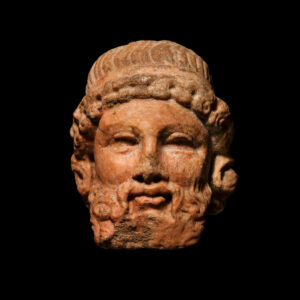
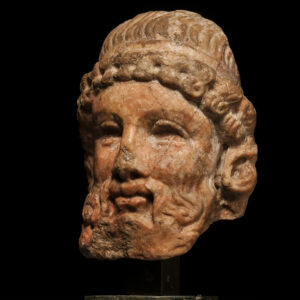
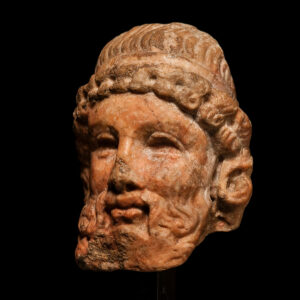
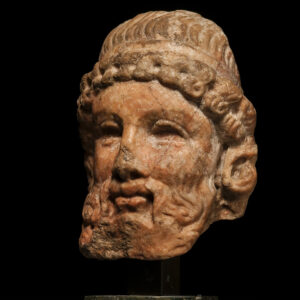
Dionysus, the god of wine, is portrayed frontal, looking forward. His hair is tied with a thick fillet with two rows of locks across his forehead. He has a long moustache and a square beard composed of curving locks. The face with arched eyebrows, large eyes sockets, pronounced cheeks, straight nose and a smiling mouth with fleshy lips. The Archaistic head is inspired by the Greek Archaic style, frontal and frozen, with stylized features and smiling mouth. It has a strong and majestic expression.
Reference: Cf. Anderson M. L., Nista L. (Eds.), Radiance in Stone. Sculptures in Colored Marble from the Museo Nazionale Romano, De Luca Edizioni d’Arte, Rome, 1989, p.72, fig. 9.
REFERENCE #
SI_RM_1081
CIVILIZATION
Roman, 100 C.E. – 200 C.E.
SIZE
H. 10.2 cm
CONDITION
Missing inlayed eyes and lower part of beard, chipped at the back of the upper part.
Dionysus, the god of wine, is portrayed frontal, looking forward. His hair is tied with a thick fillet with two rows of locks across his forehead. He has a long moustache and a square beard composed of curving locks. The face with arched eyebrows, large eyes sockets, pronounced cheeks, straight nose and a smiling mouth with fleshy lips. The Archaistic head is inspired by the Greek Archaic style, frontal and frozen, with stylized features and smiling mouth. It has a strong and majestic expression.
Reference: Cf. Anderson M. L., Nista L. (Eds.), Radiance in Stone. Sculptures in Colored Marble from the Museo Nazionale Romano, De Luca Edizioni d’Arte, Rome, 1989, p.72, fig. 9.[
REFERENCE #
SI_RM_1081
CIVILIZATION
Roman, 100 C.E. – 200 C.E.
SIZE
H. 10.2 cm
CONDITION
Missing inlayed eyes and lower part of beard, chipped at the back of the upper part.
$30,000.00Original price was: $30,000.00.$25,000.00Current price is: $25,000.00.
Description
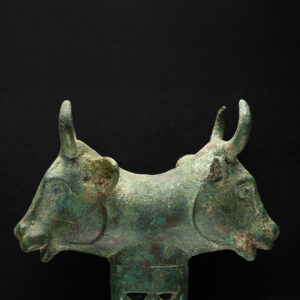
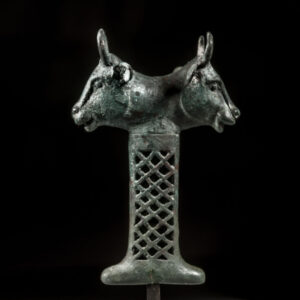
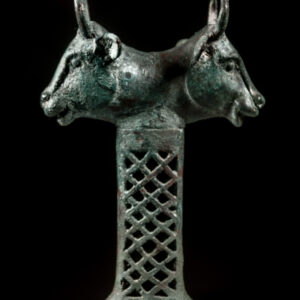
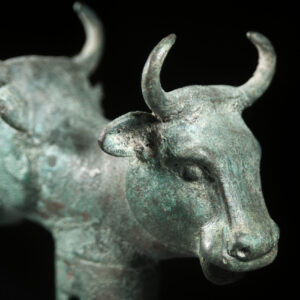
This Elamite Bronze Double-Headed Bull Mace Head, originating from the Near East region circa 2100–1550 B.C.E., is a striking example of ancient artistry and symbolism. The mace head features two imposing bull heads sculpted with remarkable detail and power, with their facial features exuding strength and dominance.
The bulls’ horns and expressions reflect the reverence for these animals in ancient cultures, often symbolizing fertility, power, and protection.
The handle, crafted in an openwork lattice style, showcases the artisan’s advanced skill in metalworking. The lattice pattern adds both aesthetic beauty and functional lightness to the piece. Though one of the bulls’ ears shows an ancient loss, the artifact remains in fine condition, its surface adorned with a rich natural patina, adding to its historical authenticity and appeal.
In the ancient Elamite kingdom, bulls were potent symbols of strength, fertility, and divine power, often associated with deities and rulers. This double-headed bull mace head likely held ceremonial or ritual significance, symbolizing authority, protection, or a connection to the divine. Its exquisite craftsmanship speaks to the advanced skills of the ancient Near Eastern metalworkers and their ability to imbue objects with profound cultural meaning.
This Elamite Bronze Double-Headed Bull Mace Head, originating from the Near East region circa 2100–1550 B.C.E., is a striking example of ancient artistry and symbolism. The mace head features two imposing bull heads sculpted with remarkable detail and power, with their facial features exuding strength and dominance.
The bulls’ horns and expressions reflect the reverence for these animals in ancient cultures, often symbolizing fertility, power, and protection.
The handle, crafted in an openwork lattice style, showcases the artisan’s advanced skill in metalworking. The lattice pattern adds both aesthetic beauty and functional lightness to the piece. Though one of the bulls’ ears shows an ancient loss, the artifact remains in fine condition, its surface adorned with a rich natural patina, adding to its historical authenticity and appeal.
In the ancient Elamite kingdom, bulls were potent symbols of strength, fertility, and divine power, often associated with deities and rulers. This double-headed bull mace head likely held ceremonial or ritual significance, symbolizing authority, protection, or a connection to the divine. Its exquisite craftsmanship speaks to the advanced skills of the ancient Near Eastern metalworkers and their ability to imbue objects with profound cultural meaning.[/vc_column_text]
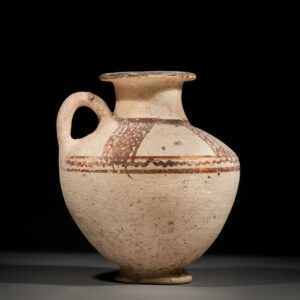
Canaanite artisans were prolific, and their pottery came in an array of fantastic shapes, colors and sizes. This white ware jug is no exception, its ghostly exterior marked with dark brown lines that zigzag across the top half of its bulbous body. A wide base supports the body itself, while the short neck above ends at a large flat mouth.
A handle rises abruptly from the body and connects at the neck’s base, making a sturdy loop for the well-worn hands of an ancient Canaanite
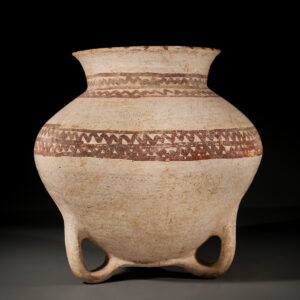
The distinctive base of this Canaanite jar is made of three looped legs that prop the body up in tripod-like fashion. The design is more aesthetically pleasing than innovative, yet the rest of the jug was carefully made to exacting standards that allowed for the flawless curves of its white ceramic exterior.
The upper half of the jug is decorated with chocolate brown bands that alternate between straight lines and tightly wound zigzags. The overall effect is an ancient artifact imbued with a timeless sense of artistry and originality.REFERENCE #
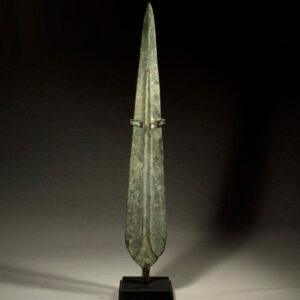
This magnificent leaf-shaped spear head was made by the Canaanites in the mid to late 2nd millennium B.C.E.. It displays excellent engineering and structural elements, particularly in terms of the bilateral central longitudinal fortified rib, widening to a broad tabular section at the butt end which was used to haft the spear head onto the shaft. The body tapers in both frontal and lateral profiles, making it a lethally effective weapon. The size also counts against anything other than a martial function, while the status associated with both warriors and large quantities of bronze (an expensive commodity at the time) marks it out as an important artifact.
Where found in context, such pieces are typically associated with prestige graves, and it would appear that they were probably as important in terms of appearance (i.e. conspicuous governance and threat) as in their evident lethality in combat. Indeed, at almost half a metre long, this piece would have been a very imposing item at the time of its manufacture, as indeed it is now. There is considerable evidence for diversity of manufacture across the Canaanite area, perhaps reflecting something of the modular yet martial nature of the time.
The Canaanites were one of the ‘tribal’ groups of what was to become Israel, Palestine and Jordan, who had their cultural roots in the Neolithic revolution when agriculture revolutionised Near East economics. By the Bronze Age the stability of the area and their position between great trading powers – notably Egypt and Mesopotamia – made them prosperous and culturally diverse, and was a high point for artistic creation. The culture contracted with economic issues suffered by Egypt and the Mesopotamians, and went through a collapse at the end of the Bronze Age due to a combination of ‘Sea People’ invasions, environmental meltdown and internal troubles in Egypt leading to loss of infrastructure throughout the Near East. Their resurgence of power in the Iron Age was matched by that of the Ammonites and Moabites, among others, and the region eventually came under control of the Neo-Assyrians by the mid 8th century B.C.E.. Such symbols of conspicuous consumption and authority are rare, especially in this excellent state of preservation and exquisite patination. This is an attractive and elegant piece of ancient art.
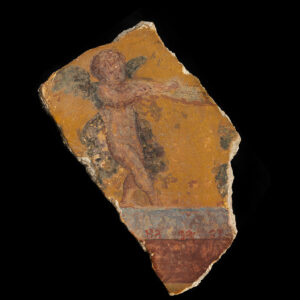
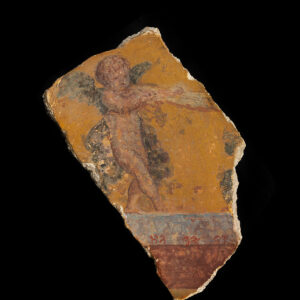
A fragment from a frieze depicting Eros as a winged child pulling on one end of a swag or garland. He is depicted naked apart from a cloak that hangs from his shoulders and behind his body, visible flapping loosely on either side of his legs. The fluttering ends of a cloak belonging to a second figure, presumably another Eros or possibly a Psyche, can be seen on the right. Painted on an ochre background with remains of two bands below of sky blue and terracotta. The edge of a lower register visible.
A fragment from a frieze depicting Eros as a winged child pulling on one end of a swag or garland. He is depicted naked apart from a cloak that hangs from his shoulders and behind his body, visible flapping loosely on either side of his legs. The fluttering ends of a cloak belonging to a second figure, presumably another Eros or possibly a Psyche, can be seen on the right. Painted on an ochre background with remains of two bands below of sky blue and terracotta. The edge of a lower register visible.
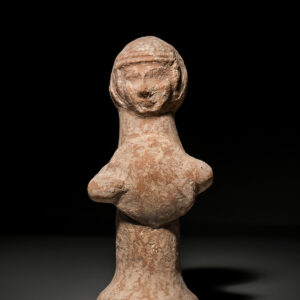
A Israelite figurine of Astarte holding a drum or bread?. The head on this figure was made in mould wearing a wig like headdress, the neck was then inserted into the pillar-shaped body. The pillar-shaped body is holding drum or bread. There is no doubt that the figurines were considered to have some magical properties and were kept in the household as amulets to enhance fertility.[/vc_column_text]
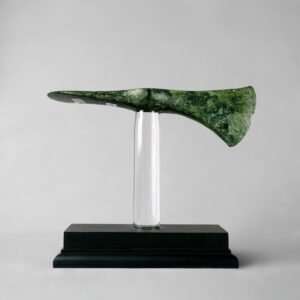
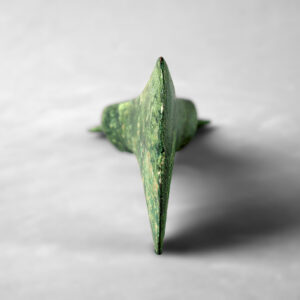
A cast bronze axe head with a cylindrical socketing shaft, a tapered spike on the back end, and a horizontal axe blade on the front.
For similar see: Nikolaus Boroffka, Simple technology. Casting moulds for axe-heads. In: Tobias L. Kienlin, Ben Roberts (ed.), Metals and society. Studies in honour of Barbara S. Ottaway.
Universitätsforschungen zur Prähistorischen Archäologie 169. Vertag
Dr. Rudolf Habelt GmbH (Bonn 2009), pp. 246-257, n. 1-2.